
Six days after something changed, you are awake at 2am working out whether what you feel is normal, whether it gets worse from here, and whether you would be wasting someone's time by asking.
Most of this was measured. Thousands of people took these medicines inside randomised trials, and every reported symptom went into a table — the adverse-reaction sections of the FDA labels, and the safety appendices of the trials that got the drugs approved. Those tables will not tell you what you will feel. They will tell you what happened, to how many people, and — the part almost nobody quotes — when.
This is educational, not medical advice. Your prescriber decides what you take and when anything about it changes.
When do GLP-1 side effects start, and when do they ease off?
They cluster in the weeks while the amount is still changing, and thin out once it stops changing. That single pattern explains more of the week-by-week experience than anything else in the data.
A pooled analysis of the STEP 1–3 trials, covering 2,117 people in the semaglutide arm and 1,262 on placebo, tracked when each person had their first gastrointestinal event. The cumulative incidence plateaued after week 20 — meaning that after roughly five months, very few people were having their first bad week. Prevalence of nausea, diarrhoea and vomiting peaked at about week 20 and declined afterwards, most steeply for nausea.
Week 20 is not arbitrary. In those trials semaglutide was escalated in planned steps, reaching its study amount at week 16 and holding there. The symptom curve peaks around the end of escalation and falls from there.
The labels say the same thing in one line each. The Wegovy label states these reactions "were most frequently reported during dosage escalation." The Zepbound label states the majority of nausea, vomiting and diarrhoea "occurred during dose escalation and decreased over time."
How common is nausea on a GLP-1, according to the trial tables?
In the semaglutide weight-management trials 44% of participants reported nausea, against 16% on placebo; in the tirzepatide trials it was 25–29% against 8%. Both figures come from approved-product labels, not from marketing material.
From the Wegovy label's pooled adult trials (2,116 treated, 1,261 placebo), treated versus placebo: nausea 44% vs 16%, diarrhoea 30% vs 16%, vomiting 24% vs 6%, constipation 24% vs 11%. Taken together, 73% of treated participants reported some gastrointestinal reaction, against 47% on placebo. Severe ones were reported by 4.1% versus 0.9%.
From the Zepbound label's pooled Studies 1 and 2 (958 placebo, 2,519 treated across three groups): nausea 25–29% vs 8%, diarrhoea 19–23% vs 8%, vomiting 8–13% vs 2%, constipation 11–17% vs 5%. Any gastrointestinal reaction: 56% in each treated group versus 30% on placebo.
Read that placebo column, because it is the column people skip. Sixteen in every hundred people on a dummy injection reported nausea too, against 44 in every hundred on semaglutide. The gap between those two columns is the part the medicine accounts for — which means a bad week is not automatic proof of what caused it.
How long does one episode of nausea actually last?
In the pooled STEP analysis the median episode of nausea lasted 8 days, diarrhoea 3 days and vomiting 2 days — and those durations were similar to placebo. Constipation was the outlier at a median of 47 days against 35 on placebo, with prevalence levelling off around week 10.
That reframes the thing people most often fear. A rough patch is usually a patch, measured in days, not a new baseline. It also explains why constipation is the complaint that quietly outlasts the others and the one worth a specific conversation.
Half of episodes ran longer than the median, of course, and a median says nothing about severity. But if you are three days in and calculating whether you can live like this indefinitely, the trial data says most people were not asked to.
Do side effects settle once the amount stops changing?
Largely, yes — the difference between the escalation weeks and the steady weeks was measured directly. STEP 4 used a withdrawal design: 902 people went through a 20-week open-label run-in, and only those who tolerated it were randomised to continue or switch to placebo.
During that run-in, 71.4% reported a gastrointestinal event. In the randomised period that followed, new events were reported by 41.9% of those continuing and 26.1% of those switched to placebo. So the excess did not vanish in maintenance — but it was nowhere near the run-in figure, and among people who carried on, prevalence of nausea, diarrhoea and constipation fell over time.
One number deserves to be said plainly rather than buried: 11.0% of run-in participants never reached the study amount at week 20, and adverse events accounted for 48.4% of them. Not everyone gets there, that was true inside a controlled trial with close supervision, and it is a clinical decision — not a personal failure and not something to manage alone.
Is tirzepatide easier than semaglutide?
The tirzepatide tables show lower rates, but these were separate trials in different populations and no label comparison is a head-to-head result. Treat the two sets of numbers as two independent measurements, not a ranking.
What can be said from each trial on its own terms: in SURMOUNT-1, adverse events caused discontinuation in 4.3%, 7.1% and 6.2% of the three tirzepatide groups versus 2.6% on placebo, and the authors record that gastrointestinal adverse events were mostly mild to moderate and occurred primarily during dose escalation. In STEP 1, 4.5% discontinued for gastrointestinal events versus 0.8% on placebo, with nausea and diarrhoea "typically transient and mild-to-moderate in severity."
How long each molecule persists between injections is a different question from how often symptoms occur, and we cover that arithmetic separately.
Does feeling sick mean it is working?
No, and this was tested rather than assumed. The same pooled STEP analysis compared weight change in people who did and did not report gastrointestinal events: mean reduction was 9.6–17.1% in those without events and 11.4–17.7% in those with them. A mediation analysis found that of the additional 7.6–14.4% weight change versus placebo, less than one percentage point was mediated by gastrointestinal events.
So a woman in month two with no nausea at all is not getting less out of her protocol than her brother who spent week five on the bathroom floor. Suffering is not the mechanism, and it is not a progress bar.
What about compounded semaglutide or tirzepatide?
Compounded versions are not FDA-approved products, and none of the tables above describes them. Every rate quoted here comes from a specific approved product studied in a specific trial population. A compounded preparation has no approved label, so no adverse-reaction table, and the FDA has warned about unapproved and falsely labelled GLP-1 products on the US market. If that is what you are taking, say so plainly to whoever is looking after you — it changes what your record can be compared against.
What is worth writing down each week?
The date every change happened, and a severity score for each symptom against the day it occurred — because the whole pattern above is a timing pattern, and timing is exactly what memory loses first.
Three columns do most of the work: what changed and when, how each day rated, and where that day sat relative to your last injection. After two months that record answers questions no recollection can — whether this week is worse than the equivalent week last month, whether your hard days cluster at one end of the week, whether constipation started before or after something changed.
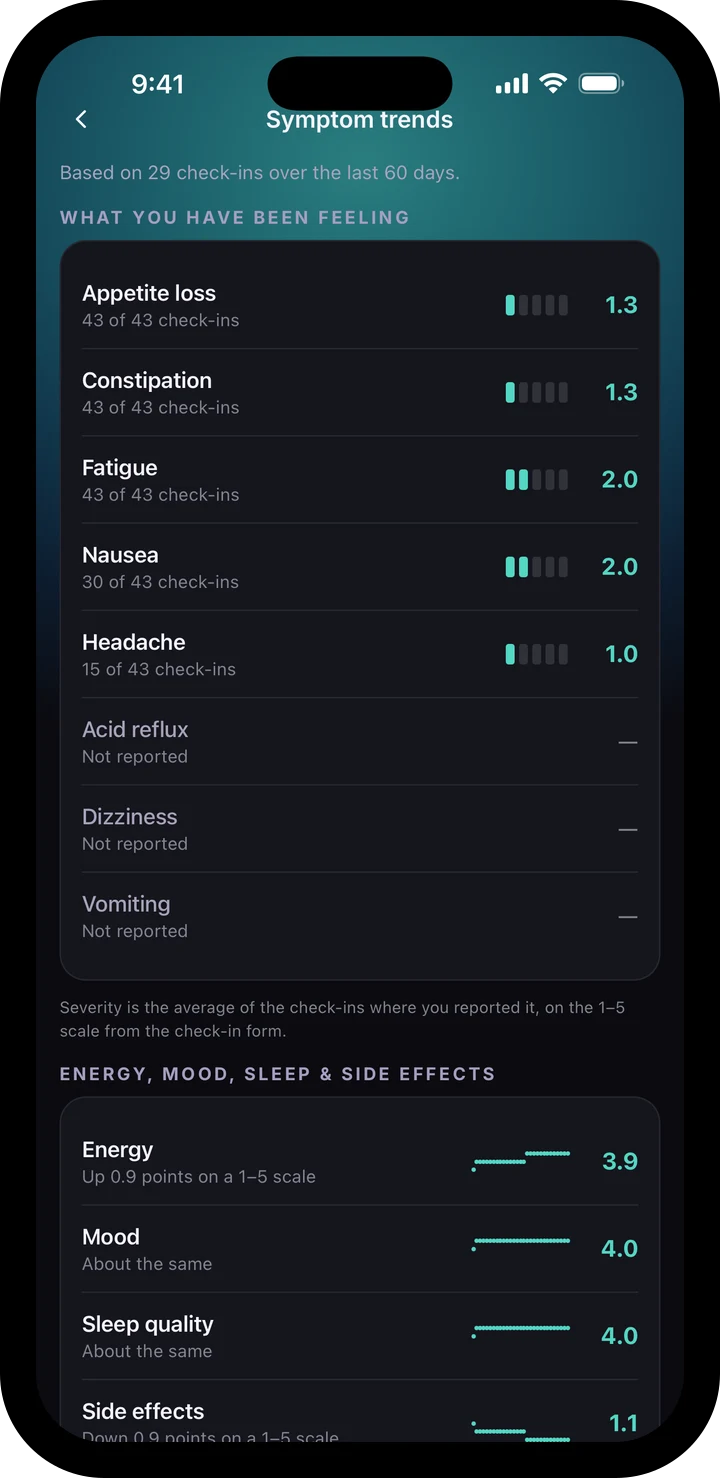
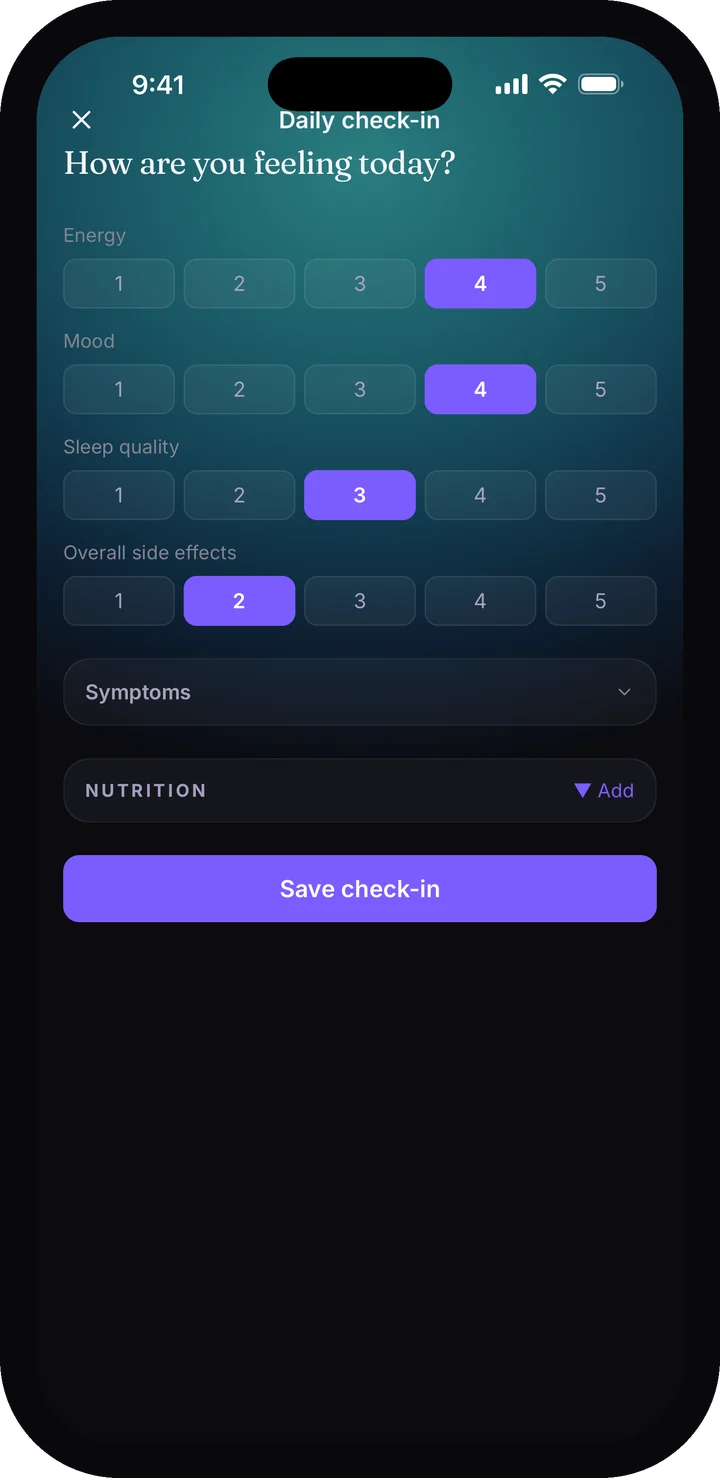
Lumara's GLP-1 tracker keeps most of that record: a daily check-in that scores nausea, vomiting and constipation, the dates things changed, and your weight and wearable data, ready to hand to the person who decides what happens next. Diarrhoea has no field of its own in the check-in, so keep a note of it alongside. For what else belongs in a weekly entry, start with our guide to tracking a GLP-1.