
You started a GLP-1. Your prescriber set the dose and the schedule, and told you roughly what to expect. Six weeks later you are at an appointment being asked how it has been going, and the honest answer is that you are not sure.
That is not a memory failure. It is a mismatch between how the medication works and how we naturally observe. A GLP-1 moves slowly — slowly enough that nothing you notice on any single day tells you much — while the things worth noticing are small, daily, and easy to lose.
This guide is about closing that gap: what is worth writing down each week, why those particular things, and how to read what you end up with. It is educational, not medical advice. Your prescriber decides what you take and when.
Why a GLP-1 rewards tracking more than most medications
Most medicines you feel quickly or not at all. A GLP-1 sits in an awkward middle: the effects are real, gradual, and confounded by everything else in your life.
The drug's own timing is the reason. Semaglutide has an elimination half-life of about one week, and the FDA label notes that it takes four to five weeks of weekly dosing to reach steady state — and that it stays in circulation for five to seven weeks after the last injection. Tirzepatide's half-life is around five days, with steady state reached after about four weeks.
Read that again with your own experience next to it. For the first month on any given dose, the amount in your body is still climbing. The week you feel worst may not be the week that tells you most. And if something changes two weeks after a dose adjustment, the adjustment is a plausible cause in a way it would not be for a medication that clears overnight.
This is also why week-to-week memory fails so reliably. You are being asked to detect a slow trend through daily noise — sleep, stress, hydration, salt, where you are in a cycle, whether you travelled. A record does not remove the noise. It just means you are looking at forty data points instead of remembering three.

What to record each week
Six things. None takes more than a few seconds, and each earns its place by answering a question you will actually be asked.
1. The dose you actually took, and when
Not what was prescribed — what happened. If Thursday's injection slipped to Saturday, that is the useful fact. If you missed one entirely, that is useful too.
This matters more than it sounds. Every other pattern in your record is read against the dose timeline: nausea on day two means something different from nausea on day six. Without the actual dates, the rest of the data has nothing to be measured against.
It is also the number your prescriber cannot get any other way. A pharmacy refill history shows what you collected, not what you took.
2. Weight, on a consistent cadence
The evidence on self-weighing is unusually consistent for a behavioural finding: more frequent weighing is associated with better weight outcomes across a large body of literature, and a cohort study of roughly 10,000 smart-scale users found daily weighing associated with weight loss across BMI groups, while weighing every other day or less was associated with unchanged or increased weight.
The mechanism is not mystical. Frequent measurement turns a number you dread into a number you are used to, and it gives a trend line enough points to be readable.
Two practical notes. Same conditions each time — morning, after the bathroom, before eating — because day-to-day swings of a kilo or two are mostly water and will otherwise drown the signal. And read the trend, never the reading: a single morning tells you almost nothing.
3. Gastrointestinal symptoms, with timing and severity
Nausea, reflux, constipation, diarrhoea. These are the most common adverse events with GLP-1s, and in pooled data from the STEP 1–3 trials nausea occurred in around 44% of participants on semaglutide versus about 16% on placebo, with diarrhoea, vomiting and constipation also elevated.
The part worth knowing is the shape rather than the rate. The trial data describe these events as overwhelmingly mild-to-moderate, non-serious and transient, clustering during or shortly after dose escalation rather than during maintenance. More of them occurred during the run-in escalation period than during a randomised period twice as long.
So record two things beyond the symptom itself: how bad, on any consistent scale, and how many days after the injection. If your worst days reliably fall in the forty-eight hours after a dose, that is a pattern. If they are scattered, it is probably something else — and knowing that is just as valuable.
4. Appetite and fullness
The subjective one, and the one people skip. It is worth a note because it tends to change before the scale does, and because it is the effect most likely to fade in a way you want to mention.
You do not need a scale for this. "Ate less than usual without trying" versus "hungry all afternoon" is enough resolution to see a pattern over eight weeks.
5. Energy and sleep
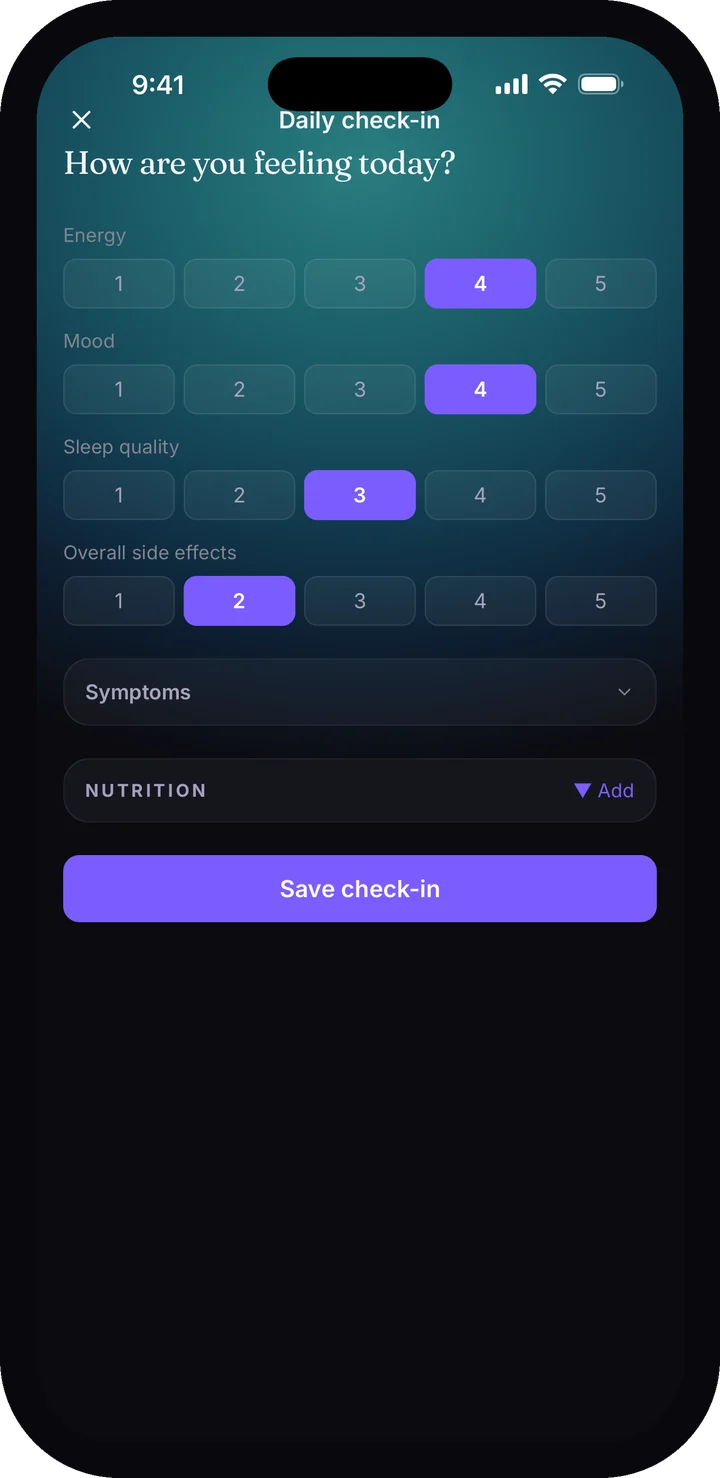
Ten seconds. Energy, mood, sleep quality on whatever simple scale you will use consistently.
These are the ones that make everything else interpretable. A bad fortnight reads very differently when the record shows you also slept badly through it.
6. The injection site, if you inject
A note of where, so you rotate without keeping a mental list. Site soreness and lumps are worth recording for the same reason as anything else: if they cluster in one area, that is information.
Why weekly, not daily
The medication has a weekly rhythm, so your review should too.
Log the small things daily — a dose takes two taps, a check-in ten seconds. But look at it weekly. A week is long enough to average out a bad night and short enough to catch something changing. It also matches how a dose interval actually feels: the first days after an injection are not the same as the last.
Then, once a month, look at the whole span. That is the scale at which a GLP-1 actually shows you anything.
What a wearable adds — and what it does not
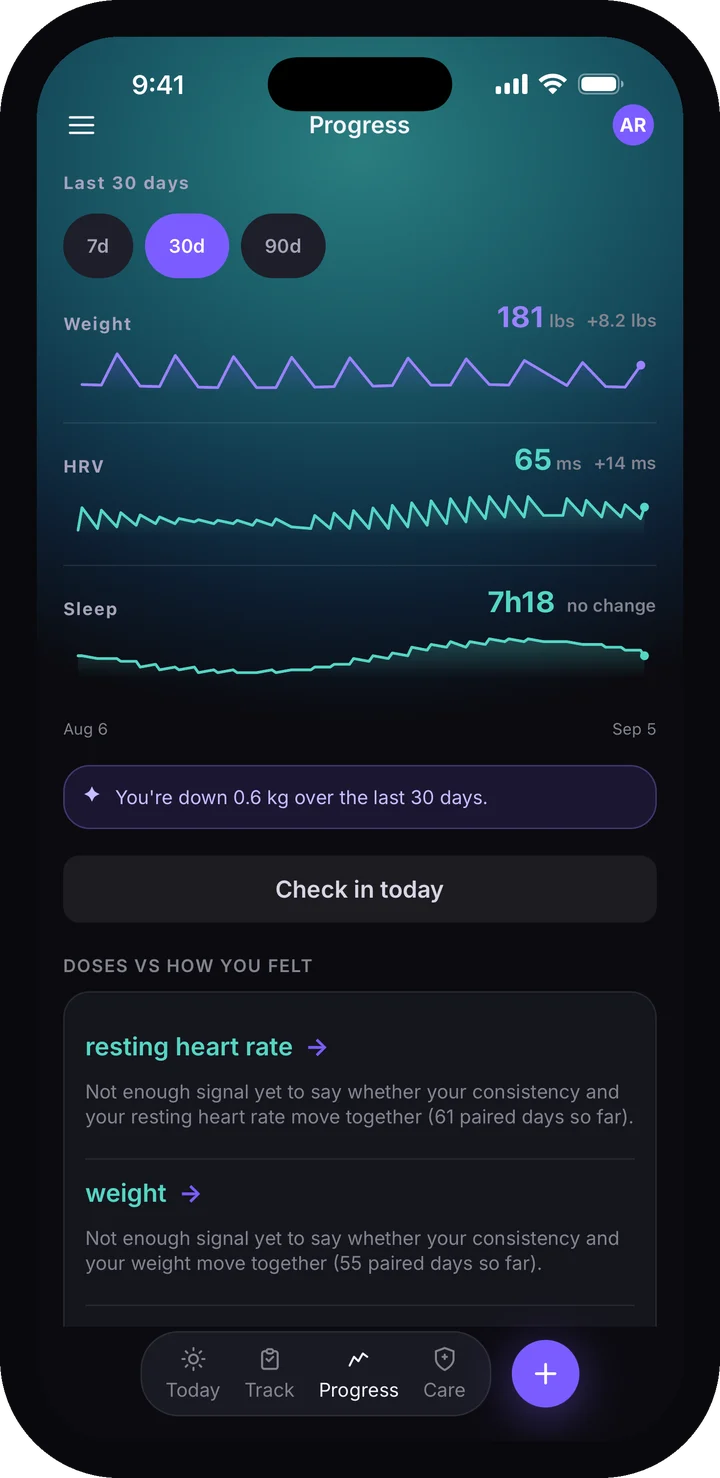
If you already wear something that records sleep, resting heart rate and heart-rate variability, that data is worth putting on the same timeline as your doses. Not because it will explain anything on its own, but because it is the only part of the picture collected without you remembering to collect it.
Two honest caveats.
These are your own baselines, not population ones. A resting heart rate that would be unremarkable for one person is a meaningful shift for another. Only the trend against your own history means anything.
A pattern is not a cause. If your sleep averages better in the weeks after a dose, that is an observation worth mentioning to your prescriber. It is not evidence the medication improved your sleep — you also changed what you ate, how much you weighed and possibly how much you moved, and any of those could be doing the work. Anything that tells you it has found the cause is overreaching.
The first month is not the fourth month
Two periods in a GLP-1 course look completely different in a record, and people routinely mistake one for the other.
While a dose is still climbing, the amount in your body is rising week over week even though nothing about your routine changed. This is the window where the trial data put most of the gastrointestinal events, and where the temptation to draw conclusions is strongest and least justified. A rough fortnight here is common and, per those trials, usually transient. Record it — the severity and the timing matter, and your prescriber will want both — but be slow to conclude anything from it.
Once things are steady, the picture gets more honest. Levels are no longer moving on their own, so what your record shows is closer to a real response. This is the period worth comparing against, and it is the reason a record that only covers your first six weeks is a poor guide to how you are actually doing.
The practical consequence: when you look back, note which period you are looking at. Comparing a steady month against an escalation fortnight is not a fair comparison, and it is the single most common way people talk themselves into believing something stopped working.
What to watch when the dose changes
A dose change restarts the clock. Levels climb again toward a new steady state over the following weeks, so both the effects and the side effects can shift — and they shift on the medication's timescale rather than immediately.
What is worth capturing around a change:
- The date it changed. Everything after is read against it.
- The fortnight either side. Your symptom and weight records for the two weeks before and after are what make a comparison possible at all.
- Whether anything came back. Nausea returning after a change is a different observation from nausea that never left, and only a record distinguishes them.
None of that tells you whether the change was right. That judgement belongs to your prescriber, and it is better made with a fortnight of your actual data than with a recollection formed on the drive over.
When the scale stops moving
Weight loss is not linear, and a flat stretch is the point at which most people start searching. It is also where the internet is least helpful, because the honest answer depends on things only your own record contains.
What a record lets you check, in order:
Is it actually flat, or are you reading noise? Two weeks is not a plateau. Day-to-day variation of a kilo or more is ordinary, and the only way to tell a stall from a wobble is a trend across several weeks.
Did your doses actually happen? Missed or shifted injections are the first thing to rule out, and the first thing memory gets wrong.
Did something else change at the same time? A new medication, a travel fortnight, a period of bad sleep, an injury that stopped you moving. A record makes these visible; recollection tends to erase them.
Has appetite changed? If the appetite effect has shifted, that is a concrete, specific thing to raise — far more useful at an appointment than "it stopped working".
What none of that answers is what to do about it. Dose changes, switching, adding or stopping anything — those are conversations with a prescriber, and this is a tracking tool, not a participant in that decision.
Bodyweight is not the only outcome
A scale measures one thing badly: it cannot tell you what the weight was made of, and it is the outcome most sensitive to salt, hydration and timing.
Without adding equipment, a few other things are worth having in the same record:
- How your clothes fit, noted every few weeks. Cruder than a scale, and sometimes more informative when the scale is flat.
- Strength or activity you can measure, however roughly — the stairs you take, the walk you do, the weight you lift. Losing weight while losing capability is worth noticing early, and it is a real and discussed consideration during rapid weight loss.
- Lab work your provider orders, kept with dates so a value can be read as a trend rather than a single number.
The point is not to accumulate metrics. It is that a record containing only weight can only ever tell you a story about weight.
How to read your own record
Three habits make a record useful rather than decorative.
Look at the trend line, not the last point. This is the whole discipline. Any individual weight, any single bad day, any one night of poor sleep is noise. Four weeks of direction is signal.
Line symptoms up against dose dates. The question is never "did I feel sick" but "when, relative to the injection". That is the comparison that distinguishes a medication effect from a coincidence, and it is the one your record can make and your memory cannot.
Notice what did not change. A record is as useful for ruling things out. If your energy has been flat across eight weeks while your weight moved, that is worth knowing — and it is the kind of thing nobody remembers, because nothing happened.
What to bring to an appointment
Your prescriber has minutes, not an evening. What helps is not a data dump but a short, specific summary:
- What you actually took, including the doses you missed or moved.
- The weight trend across the period, not today's number.
- Your two or three most common symptoms, with when they tend to fall relative to a dose.
- Anything that changed suddenly, with the date.
- The questions you want answered, written down before you get there.
A one-page version of that is worth more than a spreadsheet, because it can actually be read inside an appointment.
What tracking will not do
It will not tell you what to take. It will not tell you whether to change anything, and it will not tell you why something happened — only that it did, and when.
It also will not make a bad week into a good one. What it does is stop a bad week from becoming the entire story you tell about a medication you have been on for four months, because the record remembers the other fifteen weeks and you do not.
That is the honest value of it: not insight, but evidence. You bring the evidence; the person who prescribed it brings the judgement.