
You added the second medication in March. By May you are tired in a way you were not in February, your sleep is worse, and your libido has moved — and every one of those could plausibly be the GLP-1 or the testosterone, the GLP-1 or the estradiol. Your provider asks when it started and whether anything else changed around then. You genuinely do not know.
Running a GLP-1 alongside TRT or HRT is not twice the tracking. It is a different tracking problem — because the moment two protocols overlap, every symptom has two candidate causes, and every lab result has a reason to move that may have nothing to do with the medication you are asking about.
This post is about that overlap: two schedules on one timeline, what weight change does to hormone labs, and how to bring a provider something better than a shrug. It is educational, not medical advice — your prescriber sets every amount and every schedule involved.
Why is it so hard to tell which medication caused a symptom?
Because the symptom lists overlap heavily, and because most people change two things within the same few weeks.
Fatigue, low mood, disturbed sleep, appetite change, a shift in libido: each of those sits on the plausible list for a GLP-1, for testosterone therapy, and for menopausal hormone therapy. The experience itself carries no label saying which one produced it.
What can separate them is sequence. If two protocols begin — or change — weeks apart rather than on the same day, the gap between them is the cleanest natural experiment you will get: for that stretch, only one variable moved. Whether a gap is appropriate is entirely your prescriber's call; a symptom that needs treating now is not going to wait for a tidy timeline.
What is fully in your control is dating the changes. Attribution is not a feeling, it is a comparison of timestamps — and the record has to include every change, not just the obvious ones: a started or stopped medication, an adjustment your provider made, a missed week, a pharmacy or brand switch, a new patch site, a holiday that wrecked the schedule.
Six weeks later, "I think it was around Easter" is not a usable answer. A dated line is.
What does losing weight do to my hormone labs?
It moves them — sometimes enough that a panel changes while your hormone protocol has not changed at all.
Neither of the next two studies used a GLP-1 — both looked at weight loss from dieting or surgery. They are the reason a weight change is worth recording next to a lab result at all.
For men, the clearest evidence is a 2013 systematic review and meta-analysis of 24 studies in men with obesity: both low-calorie dieting and bariatric surgery were associated with significant increases in total testosterone, bound and unbound, with the biggest rises in those who lost the most weight. The same analysis found weight loss associated with a fall in estradiol and a rise in gonadotropins.
For women, a 2012 randomised controlled trial in 439 overweight or obese postmenopausal women measured the same question directly. Compared with controls, the dietary weight-loss arm saw estradiol fall 16.2%, free estradiol fall 21.4%, free testosterone fall 10.0% — and sex hormone-binding globulin rise 22.4%. Greater weight loss produced stronger effects on the estrogens and on SHBG.
The SHBG figure is the one that trips people up. SHBG decides how much of a total hormone number is actually unbound, so "total testosterone went up" and "more testosterone is available" are not the same sentence. The 2018 Endocrine Society guideline on testosterone therapy in men lists obesity among the conditions that alter SHBG, and recommends measuring free testosterone in men who have them.
One study has looked at a GLP-1 in this setting directly. A 16-week randomised, open-label study of 30 men with obesity and functional hypogonadism compared a GLP-1 receptor agonist against transdermal testosterone: total testosterone rose significantly in both arms, and LH and FSH rose significantly only in the GLP-1 arm. Thirty men, sixteen weeks, one compound, no blinding — that is not a reason to expect anything in particular, and the authors do not separate how much of the difference is the weight lost and how much is anything else.
None of this tells you what to do. It tells you what your provider is weighing when they read your panel: how much of the movement is the hormone protocol, and how much is the weight.
Can a GLP-1 change how my hormone medication is absorbed?
Only if that medication is swallowed.
GLP-1s slow gastric emptying, and the labels say what follows from that. The Wegovy label states that the delay has the potential to impact the absorption of concomitantly administered oral medications, and advises considering increased clinical or laboratory monitoring for oral medications that have a narrow therapeutic index or that require clinical monitoring.
The one number that label puts on it is worth reading closely, because it is routinely quoted without its context. Levothyroxine exposure increased 33% — in a drug-interaction study of the semaglutide tablet. The same label states that in clinical pharmacology trials with the once-weekly injection, semaglutide did not affect the absorption of orally administered medications. Route matters on both sides of the interaction, and a figure from the oral form is not a finding about the injection.
Labels also differ from each other, which is why the one in your hand is the one that counts. The Mounjaro label — an injection — advises patients using oral hormonal contraceptives to switch to a non-oral method or add a barrier method for four weeks after starting and for four weeks after each dose escalation, and notes that hormonal contraceptives not administered orally should not be affected. Contraception is not hormone replacement, and this is not a statement about estradiol or progesterone. What it does show is that the gut question is a real one, and that whether it applies to you is a question for the prescriber or pharmacist who can see your whole list.
Route is therefore worth recording next to the medication name. An injected testosterone ester, a transdermal gel, an estradiol patch and vaginal estradiol never meet the stomach. Oral estradiol, oral progesterone and levothyroxine do.
Two regulatory facts, stated plainly. Compounded semaglutide and tirzepatide are not FDA-approved products — the agency has warned about unapproved and falsely labelled compounded GLP-1s, and no approved label covers a compounded preparation. And testosterone therapy for women is off-label in most countries: the 2019 Global Consensus Position Statement, endorsed by eleven professional societies, notes that in most countries women are prescribed male formulations with modification, or compounded preparations, because no female product is approved.
How do I keep two schedules readable on one timeline?
By recording both in the same place, against the same clock — one timeline, not one app per protocol.
Two protocols rarely share a rhythm. A weekly injectable sits alongside a daily tablet, a twice-weekly patch, or an injection on a cadence that lines up with the GLP-1 some weeks and not others. Kept in separate places, those records cannot be laid over each other — which is exactly the comparison you need.
A few things earn their place in the log:
- Which compound, and by which route. Route decides whether the absorption question above applies at all.
- Date and time of every administration, including the ones you missed. A gap is data.
- Injection site. If both protocols involve a subcutaneous injection, they are competing for the same real estate; a site record stops you returning to the same spot without noticing.
- Symptoms, dated, with a rough severity. Written the day they happen, not reconstructed at the appointment.
- Labs, with the date drawn — and, for an injected hormone, where in the interval between injections the draw fell.
Weight alone answers less than you would hope. In the DXA substudy of SURMOUNT-1, roughly 75% of the weight lost was fat mass and roughly 25% was lean mass, in both the treatment and placebo groups. Scale weight conflates those two, and if part of why you are on hormone therapy concerns muscle and body composition, that is the distinction you actually care about. Waist measurement, how your strength is tracking, and whatever your provider measures directly are each a different question from scale weight, and worth recording separately from it.

What should I have ready for the appointment?
Dates — of doses, of changes, of symptoms, and of every blood draw.
The guidelines lean on timing more than most people realise. The Endocrine Society guideline above recommends that a diagnosis rests on fasting morning total testosterone measured on two separate mornings, because levels vary through the day and between days. The AUA testosterone deficiency guideline recommends measuring haemoglobin and haematocrit before offering therapy and checking testosterone every six to twelve months on it. For menopausal hormone therapy, the 2022 hormone therapy position statement of The North American Menopause Society (now The Menopause Society) states that the risks of hormone therapy differ by type, dose, duration of use, route of administration, timing of initiation and whether a progestogen is used, and that treatment should be individualised with periodic re-evaluation. Every one of those variables is something a log records and memory does not — which is the difference between a review and a guess.
When a result is hard to read, the question your provider is really asking is what else was moving at the time. A timeline answers that. Memory does not.
Where do two protocols live on one screen?
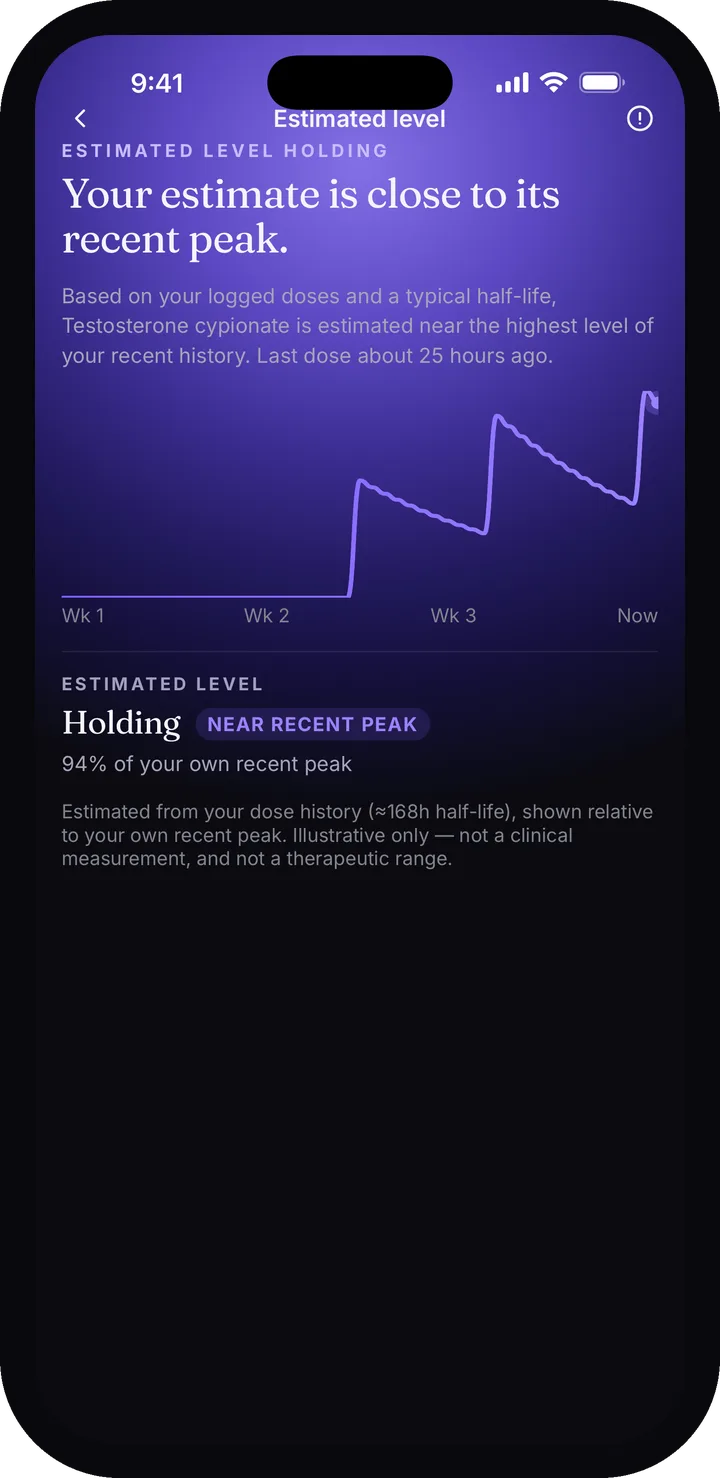
That is what Lumara's GLP-1 and TRT tracker is built for: both protocols in one record, with sites, symptoms and weight recorded against the same dates, so the comparison is there when someone asks for it. Free allows one medication of your own at a time, plus any a clinic assigns; a second medication of your own and lab results come with Premium.
For what belongs in a weekly record on the GLP-1 side, see our guide to tracking a GLP-1. And if you are trying to work out why week three of an unchanged schedule feels different from week one, GLP-1 half-life, explained covers the arithmetic behind it.