
The vial arrived and the label reads like a physics problem: a number in milligrams, a number in millilitres, a slash between them. The syringe in the same box is marked 0 to 100 and says "mg" nowhere. Your prescriber gave you an amount in milligrams, and not one object on the table in front of you is written in that unit.
This is a common place to get stuck with a compounded GLP-1, and it is not a failure of arithmetic. It is a unit mismatch built into how the product is supplied.
Two things first. Compounded GLP-1s are not FDA-approved products — the agency does not review a compounded drug for safety, effectiveness or quality before it is marketed, and compounding is meant for patients whose needs an approved drug cannot meet. And this post does not tell you what to measure. That comes from your prescriber and the instructions supplied with your vial; every worked example below is labelled illustrative and exists only to show the shape of the arithmetic.
What does mg/mL actually mean on a vial label?
mg/mL is a concentration — how much drug is dissolved in each millilitre of liquid, not how much drug is in the vial. It is a rate, like miles per hour: on its own it tells you nothing about how far you went.
Two numbers are doing two jobs. The strength is the total drug in the vial; the volume is the liquid it is dissolved in. The concentration is the first divided by the second.
Illustrative: a vial holding 20 mg of drug in 4 mL of liquid sits at 5 mg/mL. The same 20 mg in 2 mL would be 10 mg/mL — a doubled concentration holding an identical amount of medicine. Half the liquid, same drug.
Two vials can contain exactly the same amount of the same drug and still require completely different volumes to measure the same amount out. That fact drives everything else here.
Approved pens work the same way and simply hide it. Ozempic's prescribing information lists three pen concentrations of the same molecule — 0.68, 1.34 and 2.68 mg/mL — but the pen converts internally, so the user never meets the number. A vial and a syringe hand that job to you.
Why is an insulin syringe marked in units instead of millilitres?
Because it was designed for insulin, which is prescribed in units — and on a standard U-100 syringe, 100 units is exactly 1 mL. U-100 is a statement about concentration: traditional insulin products contain 100 units of insulin per millilitre, so a barrel graduated in insulin units is really a volume scale in disguise. The conversion is fixed, and has nothing to do with which drug is in the barrel:
- 100 units = 1 mL
- 50 units = 0.5 mL
- 10 units = 0.1 mL
- 1 unit = 0.01 mL
Here is the trap: a mark on that barrel measures a volume borrowed from insulin, not an amount of your medication. When a compounded product is described in "units", the word carries two meanings at the same time — and the FDA has said confusion between millilitres, milligrams and "units" may have contributed to real dosing errors.
Why does the same prescribed amount come out as a different volume?
Because volume equals amount divided by concentration, and the concentration is a property of the vial, not of the prescription.
Illustrative, to show the mechanism:
- From a vial at 5 mg/mL, an amount of 1 mg occupies 1 ÷ 5 = 0.2 mL, which lands on the 20 mark of a U-100 syringe.
- The same 1 mg from a vial at 10 mg/mL occupies 1 ÷ 10 = 0.1 mL, which lands on the 10 mark.
Same amount of medicine, half the liquid. The number on the syringe changed because the vial changed, and for no other reason.
Run it backwards for the check that matters most: the 20 mark is 1 mg from the first vial and 2 mg from the second, and nothing on the syringe tells you which.
Where does this go wrong most often?
The characteristic failure is reading a number in one unit and measuring it in another. In July 2024 the FDA alerted providers, compounders and patients to dosing errors with compounded injectable semaglutide. Its example: patients given a U-100 syringe and an instruction expressed in units, where an intended 5-unit — 0.05 mL — amount was measured as 50 units instead.
Most of those reports described a patient drawing up five to 20 times the intended amount; a separate set came from providers themselves miscalculating the conversion, producing five to ten times. Reported adverse events included nausea, vomiting, abdominal pain, fainting, headache, migraine, dehydration, acute pancreatitis and gallstones, and some patients sought medical attention or required hospitalisation.
Two situations the FDA flags specifically. One is a product whose instructions are written in "units" rather than milligrams or millilitres, because the label's units and the syringe's look identical and are not. The other is varying concentration — the agency notes that concentrations differ between compounders and that a single compounder may offer several — so the arithmetic can change silently underneath an unchanged habit. The man three months in who no longer reads the label and the woman whose second vial comes from another pharmacy meet the same failure from opposite directions.
What does "not FDA-approved" mean in practice here?
It means the product did not go through the FDA's review before it reached you. Compounded drugs are not FDA-approved; the agency does not verify their safety, effectiveness or quality before they are marketed, and it has separately raised concerns about unapproved GLP-1 drugs sold for weight loss. Oversight is not absent — state boards of pharmacy have day-to-day responsibility for state-licensed pharmacies, and outsourcing facilities registered under section 503B are inspected by the FDA — but none of it is the approval process standing behind a pen.
Three consequences follow for label-reading. The concentration is chosen by whoever compounded it, so it may differ between compounders, and one compounder may offer several. Some products carry instructions written in the very unit the FDA identified as a source of confusion. And there is no approved label for your particular vial to check against. None of that makes the arithmetic harder — it makes it more important to redo, because fewer assumptions carry over.
What to write down each time a vial arrives
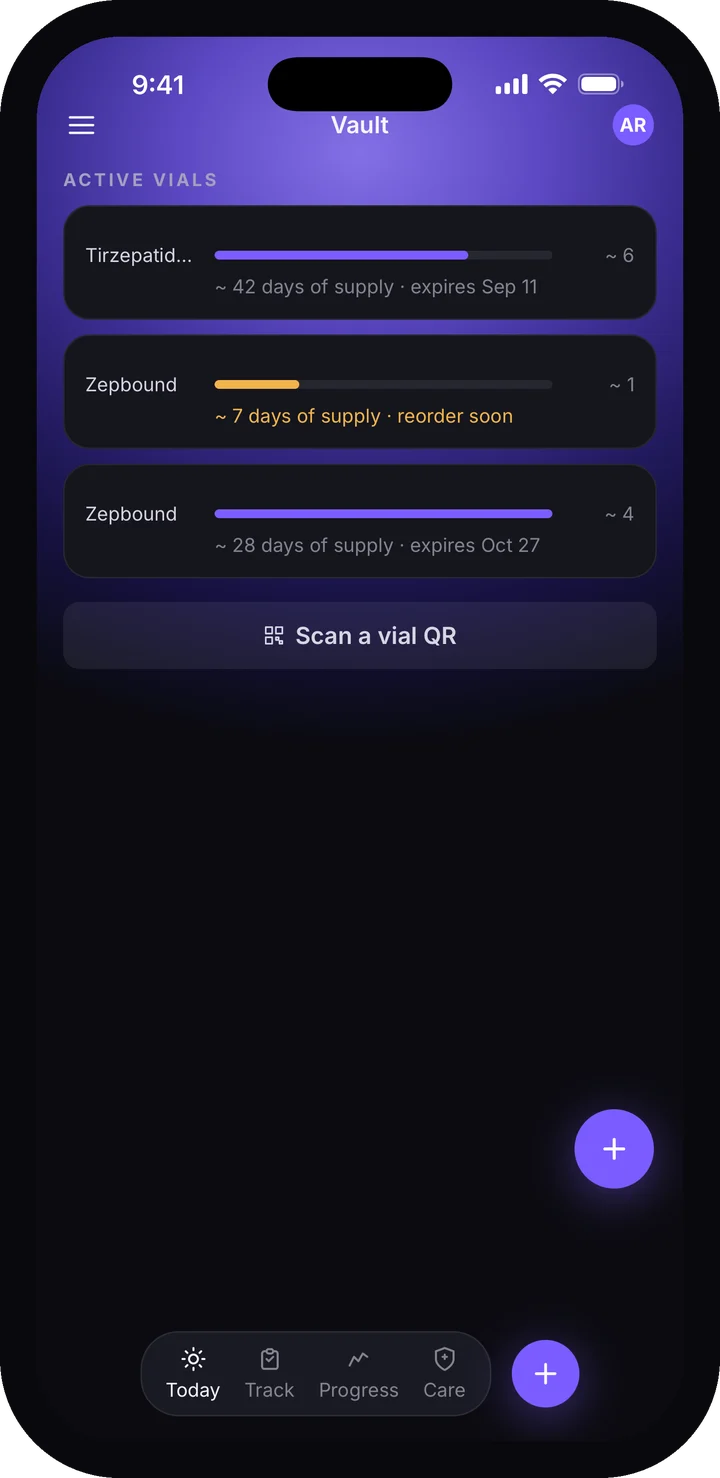
Five things, recorded per vial, keep the arithmetic checkable and give your prescriber something concrete:
- The concentration in mg/mL, copied from the label rather than remembered.
- Which unit the instructions use — mg, mL or units — and which of those your syringe measures.
- The syringe capacity, since a volume larger than it is a red flag on its face.
- The date the vial was opened, and any beyond-use date printed on it.
- Whether anything changed from the last vial. The one people skip, and the one that matters most.
The GLP-1 dose calculator does the conversion in the open: enter the vial strength, the water you added and the amount you were prescribed, and it moves between milligrams, millilitres and syringe marks, showing every step so you can check it against your label. It will not choose an amount for you — nothing here will. Keeping that vial record beside the log of what you actually took is what the GLP-1 tracker is for, and our guide to tracking a GLP-1 covers the rest of what is worth writing down each week.
The goal is not to become your own pharmacist. It is narrower: to look at a label, a syringe and a prescriber's instruction and say whether the three agree. When they do not, the right move is the boring one — stop, and ask whoever wrote the prescription.