
"I think it's working? Maybe? It's hard to say."
That sentence gets said in endocrinology and men's-health and menopause clinics every day, by people who are not being vague on purpose. A man four months into testosterone therapy genuinely cannot tell you whether the good week in March was the medication or the fact that he finally slept. A woman eight weeks into levothyroxine knows she feels different but not whether she feels better, because the thing being treated is the same thing that makes it hard to remember anything.
Hormone therapy is the category where memory fails hardest. The effects are slow, the symptoms are the ordinary noise of being alive — tired, flat, warm, foggy — and the objective measure, a blood test, happens rarely and is sensitive to what hour of what day you happened to walk into the lab.
This guide is about closing that gap. What is worth writing down on testosterone, on menopausal hormone therapy, and on thyroid medication; why blood-draw timing changes the number so much; how to weigh what you feel against what the lab says; and how long a trend needs before it means anything. It is educational, not medical advice. Your prescriber decides what you take, when, and what your targets are — nothing here changes that.
Why is hormone therapy so hard to judge by feel?
Because the symptoms it treats are non-specific, and the thing you are trying to detect is a slow trend hidden inside daily noise.
Fatigue, low mood, poor concentration, low libido, disturbed sleep, feeling cold, feeling hot — every one of those is a symptom of a hormone problem, and every one is also a symptom of a bad month. That overlap is not a failure of attention on your part. It is the reason the Endocrine Society's testosterone guideline insists that a diagnosis requires both consistent symptoms and unequivocally low, repeated morning measurements, rather than either one alone.
The second problem is speed. Thyroid replacement reaches a steady state in the blood over roughly six weeks, which is why the American Thyroid Association's hypothyroidism guideline frames re-testing in those terms rather than in days. Menopausal hormone therapy is re-evaluated on a similar scale — the European Society of Endocrinology's 2025 menopause guideline recommends reassessing treatment effects after about three months. You are being asked to detect something that moves over months, using a memory that reliably holds about a week.
A record does not remove the noise. It means that when someone asks how it has been going, you are reading forty entries instead of recalling three.
What does every hormone protocol need in the record?
Five things, whatever hormone you are on. Each one takes seconds, and each answers a question you will actually be asked at a review.
What you actually took, and when. Not the prescription — the events. The injection that slipped from Friday to Sunday, the patch that came off in the shower, the tablet you missed on the morning you overslept. Everything else in your record is read against this timeline, and it is the one fact nobody else can reconstruct. A pharmacy refill history shows what you collected, not what went in.
The route and the site, if it is not a tablet. Gels, patches, pellets, creams and injections all behave differently, and within injections the site matters for comfort and for bruising. Recording it is what turns "I get a lump sometimes" into "always the same site".
Symptoms, on a scale you will actually reuse. Consistency beats precision. A blunt one-to-five for energy, mood, sleep, and whatever your specific bothersome symptom is — hot flushes, brain fog, libido, joint aches — is worth more than an elaborate scale you abandon in week three.
Anything that moves the labs. Biotin is the notorious one: high-dose biotin in hair-skin-and-nails supplements interferes with the immunoassays many labs run, and the FDA has issued formal guidance on testing diagnostic devices for that interference. Whether you fasted, whether you had taken that morning's tablet, a new supplement, a recent illness — all of it belongs next to the result.
Lab results, with the exact date and time of the draw. Not the interpretation. The number, the units, the reference range printed on the report, and when the blood was actually taken. The next section explains why that last part matters more than almost anything else on this list.
Why does blood-draw timing matter so much?
Because hormone concentrations move through the day and through the dosing interval, so the same person can produce two very different numbers in the same week without anything having changed.
This is the single most useful thing a tracking record does for hormone therapy. A lab result without a timestamp, and without the timestamp of the most recent dose, is a number floating free of its context.
Testosterone by injection
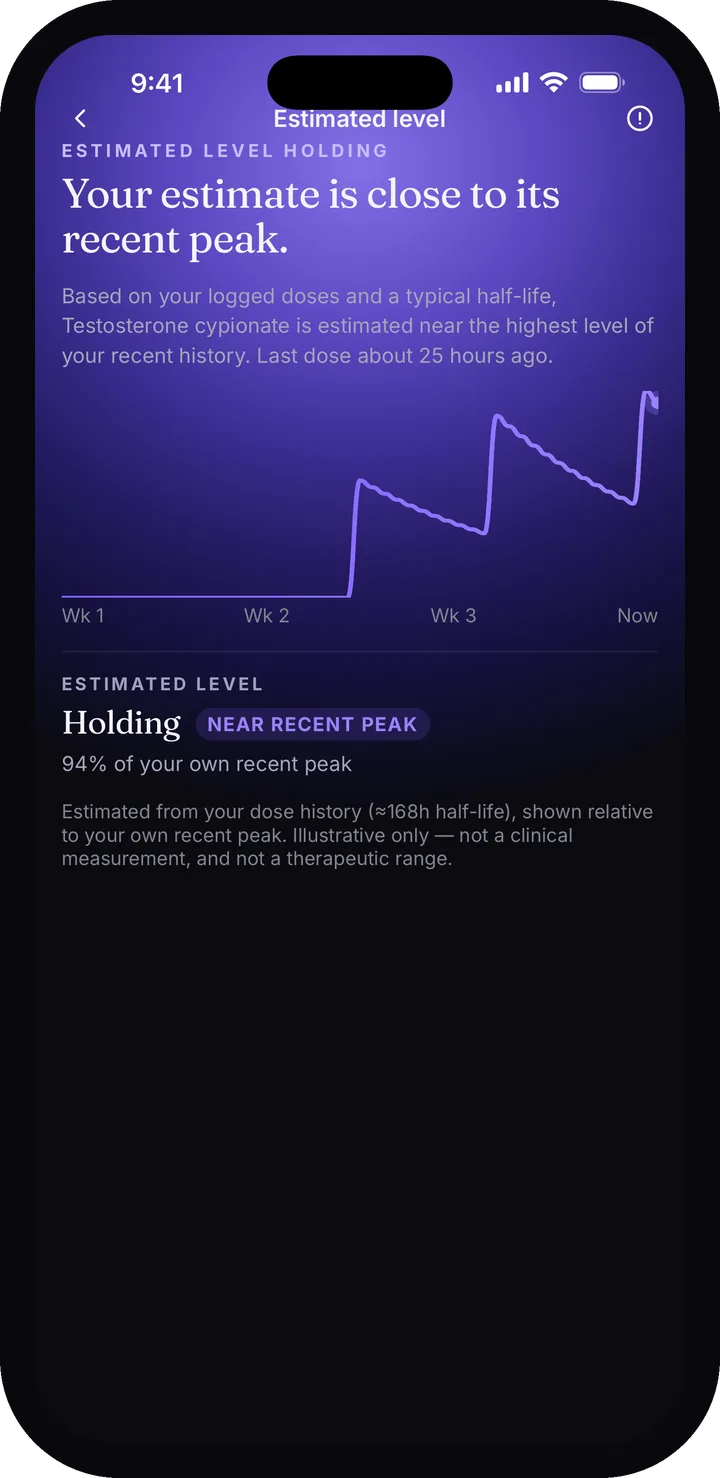
Injected testosterone esters produce a peak after the injection and a trough before the next one, so where in that cycle you are bled determines what you see. The Endocrine Society's guideline handles this by anchoring monitoring to a specific point in the interval — for testosterone enanthate or cypionate it points to measuring midway between injections, because that approximates average exposure rather than the top or the bottom of the curve.
The arithmetic is trivial and worth doing anyway. ILLUSTRATIVE: if an injection is given on a Monday and the next is due on the Monday a fortnight later, the midpoint is the Thursday of the week in between. If your last draw was done on a Friday morning the day before an injection, and the one before that was two days after one, those two numbers were never comparable — and neither of them is wrong. Only the record can tell you which was which.
Your prescriber decides which point in the cycle they want to sample and what they are aiming for. Your job is simply to know, and be able to say, exactly where in the interval the needle went in.
Testosterone or estradiol by gel, cream or patch
Transdermal products have their own timing rules, and they are on the label. The FDA prescribing information for AndroGel 1.62%, for example, titrates on a pre-dose morning serum testosterone concentration taken at about 14 and 28 days after starting or changing treatment — both when to check and when in the day. It also carries a boxed warning about secondary exposure: virilisation has been reported in children who contacted an unwashed application site, which is why "did I cover it, and who did I hug" is a genuinely useful thing to have noted.
For a topical, then, three facts make a result readable: the time you applied it, the time of the draw, and the site. Miss any of the three and you have a number without a meaning.
Thyroid medication
Thyroid has two separate timing problems, and people routinely conflate them.
The first is absorption. The ATA guideline recommends levothyroxine be taken consistently — either about an hour before breakfast or several hours after the evening meal — because food and coffee impair its absorption, and the FDA label for Synthroid carries the same empty-stomach instruction. The word doing the work there is consistently. Erratic timing produces erratic absorption, which produces lab results that look like a dose problem and are actually a breakfast problem. So log the gap between tablet and food, not just the tablet.
The second is when you are re-tested after a change. The ATA frames dose adjustment around the six weeks or so it takes for levels to reach a new steady state. A test drawn a fortnight after a change is measuring a system still in motion. If you are tracking, you will know the date of the change and can see for yourself whether enough time has passed — which is a far better question to bring to an appointment than "should we change it again?"
Should I believe my symptoms or my labs?
Both, read together — and which one leads depends on what you are being treated for.
For menopausal hormone therapy, symptoms lead. The European Society of Endocrinology guideline is explicit that biochemical testing is not necessary to diagnose or manage menopause in women over 45, and that treatment should be re-evaluated on response and tolerability rather than on a number. Blood or saliva levels are not the steering wheel here; the symptom log is. That makes a consistent daily record of hot flushes, night sweats, sleep and mood the actual outcome measure — the thing that tells you and your clinician whether the therapy is doing its job.
For thyroid, the labs lead but do not have the last word. Levothyroxine is titrated against TSH, and yet a JAMA meta-analysis of 21 randomised trials in 2,192 adults with subclinical hypothyroidism found that thyroid hormone therapy was associated with lowering TSH into the reference range, but not with a benefit in general quality of life or in thyroid-related symptoms. Normalising the number is not the same event as feeling better, and a record that holds both is the only way to see the two come apart.
For testosterone, the guideline demands both — consistent symptoms and repeated low morning measurements — before therapy is even on the table.
There is one more reason your own trend beats a single reading against a population range. In a study of 16 healthy men sampled monthly for a year, each man's own 95% range for thyroid hormones was about half the width of the group's, meaning a result can move meaningfully for you while never leaving "normal". A wide reference range is insensitive to exactly the change you are trying to detect. Your own series of results is not.
What is worth tracking on testosterone therapy?
The dose events, the symptoms it was prescribed for, and the specific things the guidelines ask to be monitored.
Beyond the universal list, three additions earn their place:
- Blood pressure. In February 2025 the FDA issued class-wide labeling changes for testosterone products, adding product-specific blood-pressure information for products with completed ambulatory blood-pressure monitoring studies, and a new blood-pressure warning to those that did not already carry one. The same action removed the boxed-warning language about adverse cardiovascular outcomes, following the TRAVERSE trial, which randomised 5,246 men with hypogonadism and pre-existing or high cardiovascular risk and found testosterone non-inferior to placebo for major adverse cardiac events — while observing a higher incidence of atrial fibrillation, acute kidney injury and pulmonary embolism in the testosterone group. A home blood-pressure reading, logged with a date, is a cheap thing to have a year's worth of.
- The blood counts your provider orders. The Endocrine Society guideline's standard follow-up plan includes measuring serum testosterone and haematocrit alongside symptoms and adverse effects. You do not have to interpret it. You do have to keep it with its date so it can be read as a line rather than a dot.
- The symptoms that justified treatment in the first place. Energy, libido, mood, morning erections, exercise recovery. If those are what it was for, those are what the review should be about.
Testosterone therapy for women deserves its own note. The Global Consensus Position Statement on testosterone therapy for women — endorsed by the Endocrine Society, the Menopause Society and others — supports one evidence-based indication in postmenopausal women, and says that where an approved female preparation is not available, off-label prescribing of an approved male formulation is reasonable if concentrations stay in the female physiological range. If that is you, log the product and the exact amount dispensed, because "off-label" also means the labelling was never written with you in mind.
What is worth tracking through perimenopause and on HRT?
A symptom diary and, while you are still cycling, your bleeding pattern — because those are the two things the staging and the treatment decisions actually run on.
Perimenopause is defined by the pattern of your cycles, not by a blood test. The STRAW+10 staging system, which remains the standard framework for reproductive ageing, is built on bleeding criteria. A single FSH result in the middle of a perimenopausal fluctuation can say almost anything; a year of cycle lengths says something real.
So the useful record here is:
- Cycle dates and flow, while there are still cycles to record.
- Vasomotor symptoms by count and severity — how many hot flushes or night sweats, how bad, which ones woke you. This is what a three-month re-evaluation of response turns on.
- Sleep, mood and cognitive symptoms, kept separately from the flushes, because they do not always move together.
- Genitourinary symptoms, kept as their own line, because they are treated differently from systemic symptoms.
- The route and what changed — patch, gel, spray, tablet, plus whichever progestogen is being used for endometrial protection, and any change of brand.
The regulatory landscape moved recently and it is worth knowing where it stands. The 2022 Menopause Society hormone therapy position statement set out the age-and-timing framing most clinicians now use. In February 2026 the FDA approved labeling changes removing the cardiovascular-disease, breast-cancer and probable-dementia risk statements from the boxed warning — a first set of six products, with further submissions from other manufacturers still to be approved. Labels change; what your record is for is making your three months legible when you and your clinician discuss it.
What is worth tracking on thyroid medication?
The dose timing relative to food, everything you take alongside it, and the date of every change — because those three explain most unexplained results.
Calcium, iron, and several other medications and supplements interfere with levothyroxine absorption, and the fix is usually separation in time rather than a different amount — the Synthroid label simply says to keep it at least four hours away from drugs known to interfere with it. That only works if you know what the current gap actually is, which means logging the supplement as carefully as the tablet.
Then log symptoms on the slow scale that thyroid actually operates on: weight, cold or heat intolerance, bowel habit, hair and skin, mood, and the fog. Weekly is plenty. Daily will mostly record the weather.
Two regulatory notes belong in every thyroid record. Desiccated thyroid extract has never been FDA-approved; in August 2025 the FDA wrote to manufacturers signalling an intention to remove these products from the market and suggesting a transition to approved products over twelve months, and the ATA issued a statement on it the following month. And compounded thyroid or hormone preparations are not FDA-reviewed for safety, quality or effectiveness at all — the National Academies' 2020 report on compounded bioidentical hormone therapy concluded that the evidence does not support its general use. If you are on either, record the exact product, strength and pharmacy, because batch-to-batch and product-to-product differences are the thing most likely to explain a result that makes no sense.
How long before a trend is readable?
Longer than feels reasonable, and the honest answer is different for each.
Thyroid levels take roughly six weeks to settle after a change, so a fair read on a change needs at least that before the blood test, plus the symptom record spanning it. Menopausal hormone therapy gets its first formal re-evaluation at about three months. Testosterone monitoring is anchored to the dosing interval, so the minimum useful unit is one full interval, and a trend needs several.
Three reading habits make the record worth keeping:
Read the line, not the last point. One bad week is weather. Six weeks of direction is a trend. This is the entire discipline, and it is the one people abandon first.
Line symptoms up against dose dates. "Did I feel rough" is unanswerable. "Do I feel rough in the two days before an injection, every time" is a pattern, and it is a pattern only a dated record can see.
Notice what did not move. A record is as useful for ruling things out. If your energy has been flat across three months while your labs normalised, that is a real finding, and it is precisely the sort of thing nobody remembers — because nothing happened.
What should I bring to an appointment?
One page, not a spreadsheet. A clinician has minutes and cannot read a data dump inside them.
What earns space: what you actually took and what you missed or moved; the dates and times of your last few doses relative to your last blood draw; your two or three most bothersome symptoms with their trend over the period; anything that changed suddenly, with a date; every supplement, including the hair-and-nails one; and the questions you want answered, written down before you arrive.
That page is not a second opinion. It is evidence — the part of the consultation that only you can supply. Doses, symptoms and lab results on one timeline is the whole job, and it is the job Lumara is built for: see how hormone tracking works.
What tracking will not do
It will not tell you what to take, or whether anything should change. It will not interpret a lab result, and it will not tell you why something happened — only that it did, and when, and what else was true that week.
It also will not make a hard six months into an easy one. What it does is stop one bad fortnight from becoming the whole story you tell about a therapy you have been on since spring, because the record remembers the other twenty weeks and you do not.
That is the honest trade. You bring the evidence. The person who prescribed it brings the judgement.