
There is a vial of white powder on the table, a bottle of bacteriostatic water beside it, and a syringe marked 0 to 100. Your prescriber gave you an amount in micrograms. Nothing in front of you is written in micrograms, and the powder is not yet a liquid you could measure anything out of.
That gap — between the number you were given and the mark you are meant to pull the plunger to — is where reconstitution lives. It is four steps long — three divisions and one multiplication — and none of them are hard. What makes it feel hard is that each step changes units, so you finish holding a number that looks nothing like the one you started from.
Two things before any arithmetic. Every number in this post is illustrative. They are invented to show the shape of the calculation; they are not a suggestion, not a "typical" anything, and not a starting point. Your prescriber sets the amount and the schedule, and the instructions supplied with your vial govern. And state the regulatory footing plainly: a peptide vial you reconstitute at home is generally a compounded preparation, and in FDA's own words, "compounded drugs are not FDA-approved" — "FDA does not verify the safety, effectiveness or quality of compounded drugs before they are marketed." Several peptide bulk substances — GHRP-2, GHRP-6, ipamorelin acetate and kisspeptin-10 among them — sit in category 2 of FDA's interim policy on bulk drug substances nominated for compounding, the bucket for substances FDA says may present significant safety risks and against which it would consider taking action against a compounder.
What does adding water actually change?
Adding water changes the concentration, never the amount of drug. The vial holds a fixed mass of freeze-dried powder. Dissolving it does not create or destroy any of it — it only spreads that mass across a volume you choose.
This is the sentence that makes the rest of the page calm. The volume of diluent you add does not make an amount larger or smaller. It only changes how far along the barrel of the syringe that amount lands.
Bacteriostatic water is a common diluent: sterile water for injection with benzyl alcohol added as a preservative — 0.9% or 1.1%, depending on the product — supplied in a multiple-dose container from which repeated withdrawals may be made. Its FDA label is blunt about scope: "FOR DRUG DILUENT USE ONLY", and "NOT FOR USE IN NEONATES".
How do you calculate concentration in mg/mL?
Divide the vial's strength in milligrams by the volume of water in millilitres. That is the entire operation.
Illustrative: a vial labelled 10 mg, reconstituted with 2 mL of bacteriostatic water.
10 mg ÷ 2 mL = 5 mg/mL
Two things to notice. The units cancel the way you would hope — mg divided by mL leaves mg/mL — and because it is a division, the water volume moves the answer inversely. The same illustrative 10 mg of powder becomes 10 mg/mL in 1 mL of water, 5 mg/mL in 2 mL, and 2.5 mg/mL in 4 mL. Identical drug, identical total, three completely different numbers waiting for you on the syringe.
Doses are often written in micrograms, so convert once and then stay in one unit: 1 mg is 1000 mcg, which makes that illustrative 5 mg/mL the same thing as 5000 mcg/mL.
How do you turn an amount in mcg into a volume in mL?
Divide the amount by the concentration. Amount ÷ concentration = volume.
Illustrative, carrying the same vial forward, for a hypothetical 250 mcg:
250 mcg ÷ 5000 mcg/mL = 0.05 mL
Check the cancellation before you look at the number: mcg divided by mcg/mL leaves mL, which is what a volume should be. If the units of your answer are wrong, the arithmetic went wrong before the digits did — and unit cancellation is the cheapest error check available to you, because it costs one glance and catches the large mistakes rather than the small ones.
Why is an insulin syringe marked in "units" rather than mL?
Because a U-100 syringe is graduated for a 100-units-per-millilitre insulin, so its scale is a millilitre scale wearing a different label. The FDA label for Humulin R gives the strength as 100 units/mL and instructs "Use only with a U-100 syringe."
Which fixes the conversion: 100 units is 1 mL, so 1 unit is 0.01 mL, and 50 units is 0.5 mL.
Carrying the illustrative volume across:
0.05 mL × 100 units/mL = 5 units
Say the middle step out loud, because it is the one people skip. The syringe measures volume and calls it units; the drug is measured as mass; only the concentration connects the two. A units figure that has lost its concentration is not information — it is a number that happened to be true for one vial.
That is not a theoretical hazard. In July 2024 the FDA issued an alert on dosing errors with compounded injectable semaglutide, naming "confusion between different units of measurement (e.g., milliliters, milligrams and 'units')" as a contributor, with reports of people administering "five to 20 times more than the intended dose" and adverse events including nausea, vomiting, abdominal pain, fainting and acute pancreatitis. Every step on this page exists to be checkable precisely because that error is so easy and so consequential.
How many doses does a vial hold?
Divide the total milligrams in the vial by the milligrams in one dose. Put both sides in the same unit first — that is where this one goes wrong.
Illustrative, same vial again: 10 mg ÷ 0.25 mg = 40 doses
The 0.25 mg is the earlier 250 mcg rewritten, not a new number. How long 40 doses lasts depends on a schedule your prescriber set, which is not something this post or any app decides. Doses per vial is arithmetic; days per vial is arithmetic plus a schedule you were given.
Neither figure overrides the discard-by date. CDC injection-safety guidance says a punctured multiple-dose vial should be dated and discarded within 28 days unless the manufacturer states otherwise, and the beyond-use date a compounder puts on your label wins over any estimate a calculator produces.
What should you write down?
Record the inputs, not just the answer — an answer you cannot reconstruct is one you will eventually recalculate wrong.
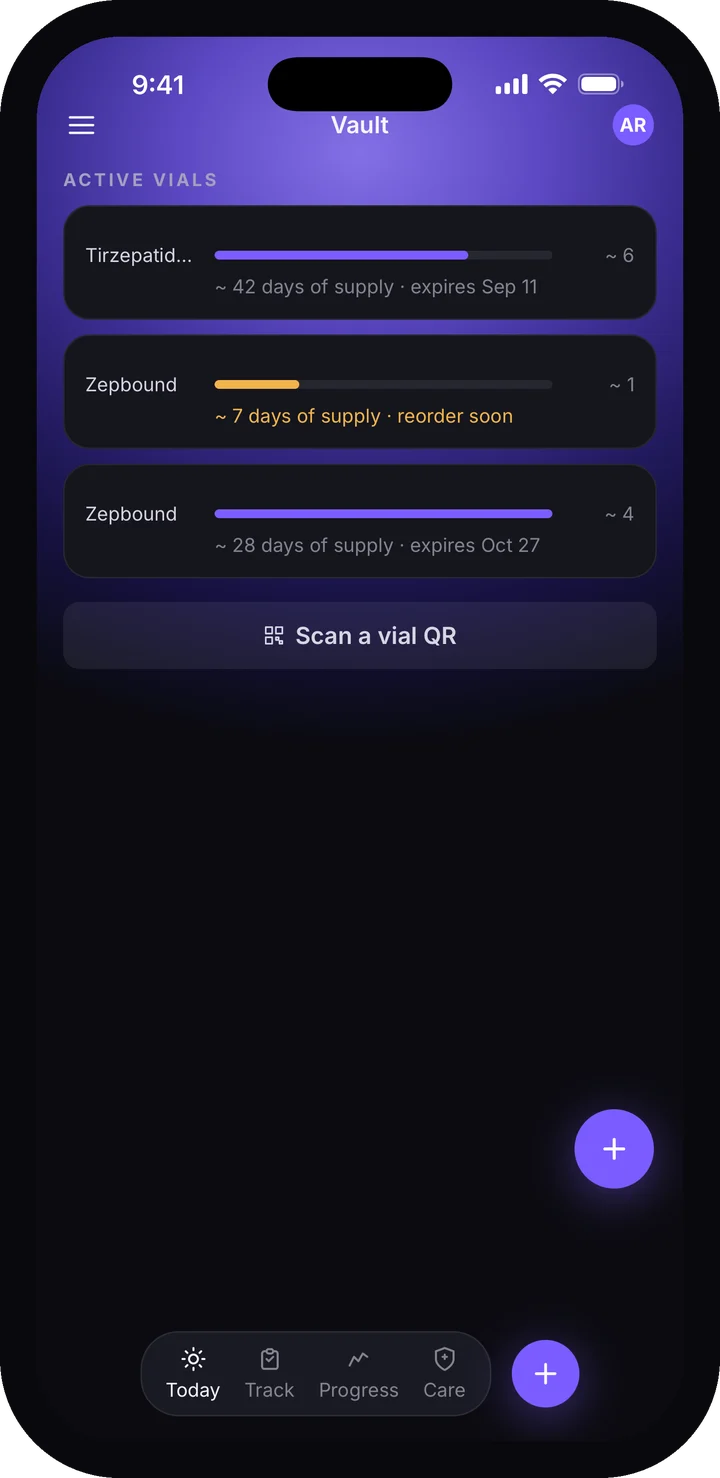
Four things are worth keeping per vial: the strength printed on the label; the exact volume of diluent added; the date it was reconstituted alongside the beyond-use date; and the syringe figure you and your provider settled on, stored next to the mass it represents. That last pairing matters most — a units number carried over from a vial mixed differently is the most ordinary way this goes wrong.
The reconstitution calculator runs these four steps and shows each one, so you can check it against the arithmetic above rather than take its word. It also solves the question backwards — given a syringe mark you would rather land on, what volume of water puts you there — and it never recommends an amount, because that is not its job. If you would rather the record kept itself, that is what the medication tracker is for; vial longevity handles the depletion side.