
There is a box somewhere in your kitchen. A vial, a bag of syringes, alcohol wipes, a sharps container that may or may not be the right kind, and a printed sheet from the pharmacy you have read four times and still do not entirely trust. Someone showed you how to do this once. Since then it has been you, the fridge, and a set of questions nobody is around to answer at nine o'clock at night.
Was that supposed to go back in the fridge? How long has this vial been open? Is that lump normal, or is it the kind of lump you call someone about? What am I meant to do with the needle?
This guide is about the handling — storage, mixing, sites, sharps — not the medicine. Your prescriber decides what you take, how much and when; nothing here changes that, and nothing here replaces the instructions that came with your medication. What follows is the part nobody spends enough time on, and where most of the avoidable problems live.
It covers every injectable handled at home — a GLP-1 pen, a testosterone or estradiol vial, fertility medication, a compounded peptide, insulin — because the physical skills are the same even when the drugs are not.
Does my injectable medication have to stay in the fridge?
It depends entirely on the product, and the difference between two products in the same category can be enormous — so the only storage instruction that matters is the one on your own label.
Three FDA-approved examples, all injectables, all handled at home:
- Tirzepatide (Mounjaro) is stored in a refrigerator at 2°C to 8°C (36°F to 46°F), in its original carton to protect it from light. A single-dose pen or single-dose vial may be kept unrefrigerated at no more than 30°C (86°F) for a total of 21 days and is then discarded — the multi-dose vial and the KwikPen carry their own, different limit. The label says not to freeze it and not to use it if it has been frozen.
- Semaglutide (Ozempic) is also refrigerated before first use, but after first use the pen can be kept for 56 days at controlled room temperature of 15°C to 30°C, or back in the fridge.
- Testosterone cypionate (Depo-Testosterone), an FDA-approved Schedule III intramuscular product, is not a fridge item at all. It is stored at controlled room temperature, 20°C to 25°C, protected from light.
Twenty-one days versus fifty-six versus never refrigerated. Those are not rules of thumb you can carry between medications, and "GLP-1s live in the fridge" is the sort of half-true shortcut that ends with a pen in the door shelf next to the milk, where the temperature swings every time someone opens it.
Oil-based hormone preparations sit in the same camp. Estradiol valerate (Delestrogen), FDA-approved and dissolved in sesame oil, is stored between 20°C and 25°C (68°F to 77°F) — USP controlled room temperature, the same window as the testosterone ester above.
What happens if something gets left out — or frozen
Heat and freezing are different failures, and freezing is usually the less forgiving one.
Both the Mounjaro and Ozempic labels say not to freeze the product and not to use it if it has been frozen. That is a flat instruction to discard, with no inspection step attached — the label does not ask you to look at it and judge.
Heat is handled differently, as a budget. Mounjaro's room-temperature allowance is written as a total — up to 21 days for a single-dose pen or vial, then discard — so it accumulates across every excursion rather than resetting overnight.
What do I do if I left my medication out overnight?
Write down exactly when it came out and when you found it, then ring the pharmacy or your prescriber with those two times — the decision is theirs, and the times are the only input they actually need from you.
That call is usually answerable. The pharmacist has the stability data; what they do not have is your timeline, and "I think it was out a while?" turns a two-minute call into a guess.
So the useful habit is unglamorous: note the time the moment you notice. Room or car? Direct sun? Carton closed? Four facts, thirty seconds — attached to a specific vial with its lot number, rather than a memory you will have revised by morning.
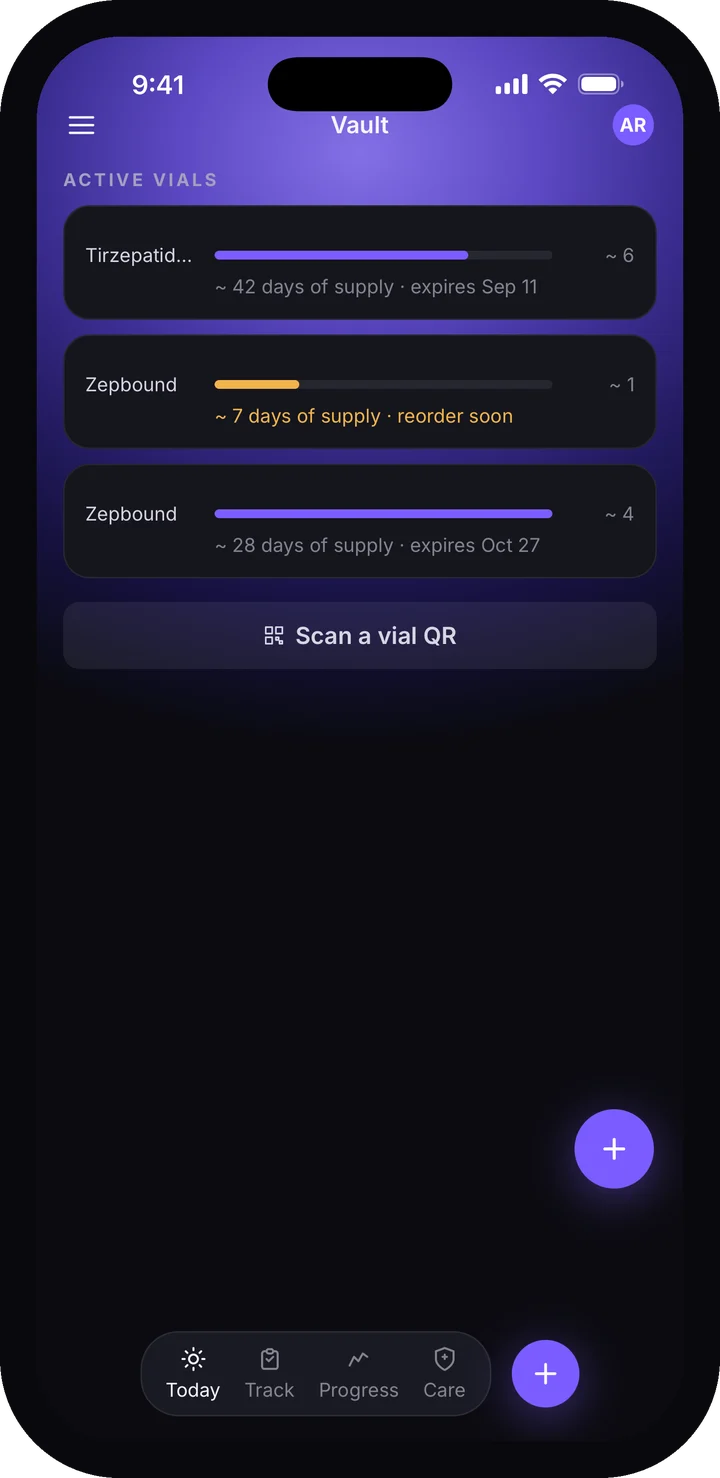
The same applies to a vial found at the back of the fridge with no idea when it was opened. That cannot be reconstructed after the fact, which is the argument for writing the date on the vial the first time you puncture it.
How do I keep this clean at home?
Aseptic technique at home comes down to five habits, and the most important is that a needle enters exactly one thing once.
The CDC's injection safety guidance is written for clinicians, but its headline principle reads the same at a kitchen table: One Needle, One Syringe, Only One Time. Its instructions are to use a new sterile syringe and needle each time, never to enter a vial with a syringe or needle that has already been used, and not to leave a needle sitting in a vial septum for repeated use.
The working version of that:
- Wash your hands and dry them before you open anything.
- Work in a clean area that is not beside a water source. CDC's wording is to prepare medications "in a designated clean medication preparation area that is not adjacent to potential sources of contamination, including sinks or other water sources" — which rules out the obvious one, a bathroom counter.
- Use a fresh alcohol swab on the rubber stopper each time, and let it dry before the needle goes in.
- Touch nothing sterile. Not the needle, not the plunger shaft, not the inside of a cap. If the needle brushes a countertop, it is done; a new one costs cents and a skin infection does not.
- Never share a pen or syringe with another person, even with a new needle. Product labels state this outright — the Ozempic label says pens "must never be shared between patients, even if the needle is changed", because "pen-sharing poses a risk for transmission of blood-borne pathogens."
One more, which people find counterintuitive: a used needle does not get recapped and set down to deal with later. The FDA's instruction is to place used sharps in the disposal container immediately, to reduce the risk of needle sticks, cuts or punctures from loose sharps; its list of don'ts also covers removing, bending, breaking or recapping a needle another person has used.
Single-dose or multi-dose vial — and how long does mine last once it is open?
In CDC's words, single-dose vials "typically lack an antimicrobial preservative" and are never for more than one use, while multi-dose vials "typically contain an antimicrobial preservative" — and once a multi-dose vial is opened it "should be dated and discarded within 28 days unless the manufacturer states another date for that opened vial."
That 28-day default is a clinical convention, and CDC states it with the manufacturer's own instructions taking precedence — so your product's label wins wherever the two differ. An unopened vial is a separate matter: CDC's instruction there is simply to discard it according to the manufacturer's expiration date.
The preservative is the whole difference, and you can see it on the label:
- Testosterone cypionate 200 mg/mL comes as both 1 mL single-dose vials and 10 mL multiple-dose vials — same drug, same strength, different vial rules. Each millilitre contains benzyl alcohol 9.45 mg as a preservative, alongside benzyl benzoate and cottonseed oil.
- Delestrogen (estradiol valerate) comes in 5 mL multiple-dose vials preserved with chlorobutanol in sesame oil.
- Bacteriostatic Water for Injection, the diluent used to reconstitute many powdered products, contains 0.9% or 1.1% benzyl alcohol "added as a bacteriostatic preservative" — which is why its label describes it as a multiple-dose container "from which repeated withdrawals may be made". It also carries the warning NOT FOR USE IN NEONATES. Preservative-free Sterile Water for Injection is the unpreserved alternative.
So two dates govern every vial in your fridge, and only one of them is printed on it:
The manufacturer's expiry is on the label. The beyond-use date is the one you create by pushing a needle through the stopper for the first time, and it exists only if you write it down. A marker on the vial, or a dated entry in whatever you use to track this, is the entire mechanism. The vial longevity calculator does the arithmetic of how many draws a vial holds and when it runs out; the date it was opened has to come from you.
Both labels also tell you to look before you use: Ozempic "should appear clear and colorless", and is not to be used if particulate matter or coloration is seen; the Mounjaro instructions say to check that the medicine is not frozen, not cloudy, colourless to slightly yellow, and free of particles. CDC's rule covers what those checks miss — discard a vial "whenever sterility is compromised or questionable". If something looks wrong, the answer is the pharmacy, not the internet.
How does reconstitution arithmetic actually work?
Reconstitution is two divisions: the drug divided by the liquid gives you a concentration, and the concentration tells you what each mark on your syringe holds.
The numbers below are ILLUSTRATIVE — invented to show the arithmetic. They are not a dose, not a recommendation, and not a starting point. The amount of drug, the volume of diluent and the volume drawn are all set by your prescriber and the pharmacy's instructions.
Suppose, illustratively, a vial is labelled 5 mg of powder, and the pharmacy's sheet calls for 2 mL of diluent. The concentration is 5 divided by 2, which is 2.5 mg per mL.
Now the syringe. A U-100 insulin syringe is graduated in units, and on that scale 100 units is 1 mL by definition — so each unit mark holds one hundredth of a millilitre. At 2.5 mg per mL, one unit mark holds 0.025 mg — that is, 25 mcg.
That second step is where home errors concentrate, because "units" on a syringe is a volume marking — nothing to do with international units of a hormone, nor with milligrams. The same vial reconstituted with a different volume of diluent gives a different concentration, and therefore a different number of marks for the identical amount of drug. This is why a number copied from a forum, where the diluent volume is unstated, is meaningless — and occasionally ten times meaningless.
The FDA has been explicit that this is not hypothetical. In its statement on unapproved GLP-1 drugs, the agency reports "multiple reports of adverse events, some requiring hospitalization, that may be related to dosing errors associated with compounded injectable semaglutide products" — errors that "resulted from patients measuring and self-administering incorrect doses of the drug, and in some cases, health care professionals miscalculating doses of the drug."
The reconstitution calculator does this arithmetic and shows its derivation, so you can check it against the pharmacy's sheet rather than against your own mental maths at the kitchen counter. It computes; it does not advise. If the two disagree, the pharmacy is the authority and the disagreement is worth a phone call.
Where should I inject, and how often should I change sites?
Product labels for subcutaneous injectables tell you to rotate sites, and the international injection technique consensus explains what rotating correctly is for: preventing lipohypertrophy, the thickened tissue that distorts how the drug is absorbed.
The Mounjaro label says to rotate injection sites with each dose, using the abdomen, thigh or back of the upper arm. The Ozempic label tells prescribers to instruct patients to use a different injection site each week when injecting within the same body region. Those two sentences are the whole rule for pens.
The reason is lipohypertrophy — thickened lumps of tissue that build up where injections repeat in the same small area. FITTER, the injection technique consensus published in Mayo Clinic Proceedings in 2016 by Frid and colleagues, states it directly: lipohypertrophy "is a frequent complication of therapy that distorts insulin absorption, and, therefore, injections and infusions should not be given into these lesions and correct site rotation will help prevent them". It was written for insulin; the tissue does not know that.
The companion questionnaire study — 13,289 insulin-injecting patients across 42 countries — found lipohypertrophy self-reported by 29.0% of them and found on physical examination by clinicians in 30.8%. It was associated with incorrect rotation of injection sites, use of smaller injection zones, longer duration of insulin use, and reuse of pen needles. Incorrect rotation and a shrinking injection zone are not opinions about technique — they are what that survey found alongside the lumps.
Intramuscular injections follow different geography. Oil-based hormone esters are IM products — Depo-Testosterone is labelled for intramuscular use only, and the Delestrogen label says care should be taken "to inject deeply into the upper, outer quadrant of the gluteal muscle" — and here the rotation that matters is alternating sides, and between whichever sites your prescriber has taught you. A man on a testosterone ester and a woman on an estradiol ester face the same question with the same answer: write down which side, every time. Nobody remembers reliably past the second month.

Rotation fails quietly — people drift back to the spot that is easiest to reach, and only notice when a lump appears. A site log catches that; intention does not.
What does a normal injection-site reaction look like?
Labels treat injection site reactions as a recognised adverse reaction — redness, swelling, pain, a lump at the spot — and, unlike a forum, they put a number on how often it happened in trials.
In the pool of placebo-controlled adult trials of tirzepatide, injection site reactions were reported in 3.2% of patients on the drug versus 0.4% on placebo — and in 4.6% of patients who developed anti-tirzepatide antibodies, against 0.7% of those who did not. The FDA's own example of an adverse event report for a compounded product lists "redness, site swelling, pain, and a red lump at the injection site".
What matters at home is not naming it. It is noticing that this one is different from your usual — larger, spreading, lasting longer, or arriving with a fever or feeling unwell — and saying so to someone who can look at it. That is a phone call, and a record of what the previous ones looked like is what makes the call worth making.
Separately, and not an injection-site question at all: hives, swelling of the lips, tongue or throat, wheeze, or faintness after an injection are emergency symptoms.
One thing not to do alone: do not repeat an injection because you saw liquid leak out and assumed some was lost — the amount is unknowable, so log what happened and ask.
How do I dispose of used needles at home?
The FDA's instruction is that every used needle, syringe and lancet goes immediately into a sharps disposal container — never into household rubbish, never into recycling, and never down the toilet.
An FDA-cleared sharps container is the intended option, and the FDA says these are "generally available through pharmacies, medical supply companies, health care providers and online", made of "puncture-resistant plastic with leak-resistant sides and bottom" with "a tight fitting, puncture-resistant lid". Where one is not available, the FDA describes a heavy-duty plastic household container as an alternative, and gives a laundry detergent container as its own example. A drinks bottle answers none of that description.
The FDA's sharps guidance adds the details people get wrong: when a container is about three-quarters full, follow your community's guidelines for getting rid of it rather than topping it up; keep all sharps and sharps containers out of reach of children and pets; and seal and label a container properly before disposal.
What varies is not the container but where it goes afterwards. In the FDA's words, "sharps disposal guidelines and programs vary depending on where you live", and the routes it lists are drop-off or supervised collection sites — doctors' offices, hospitals, pharmacies, health departments, medical waste facilities, police or fire stations — household hazardous waste collection sites, mail-back programmes, and residential special waste pick-up. Your local waste authority or pharmacy will know which of those exist where you are.
When travelling, the FDA's instruction is to carry a portable sharps disposal container with you. Safe disposal, it notes, matters "whether you are at home, at work, at school, traveling, or in other public places such as hotels, parks, and restaurants" — and loose sharps never go into a public bin.
What does "research use only" mean on a peptide vial?
It means the product was not made, tested or approved as a medicine for human use — and the FDA has taken action against companies selling exactly that material to consumers.
This needs stating plainly, because everything above quietly assumes something research-grade material does not provide: a validated label. The FDA's statement on unapproved GLP-1 drugs describes firms that illegally sold unapproved products containing semaglutide, tirzepatide, retatrutide, survodutide or mazdutide, "falsely labeled 'for research purposes' or 'not for human consumption'", then supplied them to consumers with dosing instructions.
Three distinct regulatory statuses, not points on a spectrum:
- FDA-approved products — Ozempic, Mounjaro, Depo-Testosterone, Delestrogen — have been reviewed for safety, efficacy and manufacturing quality. The label's storage windows, concentrations and beyond-use dates are tested claims.
- Compounded preparations made by a 503A or 503B pharmacy against a prescription are lawful in defined circumstances but are not FDA-approved. In the FDA's words, "the agency does not review compounded drugs for safety, effectiveness or quality before they are marketed".
- Research-use-only material is not a medicine at all. Of the versions sold this way the FDA says only that they are "of unknown quality and may be harmful to their health"; of illegally marketed GLP-1 drugs generally, that they "may be counterfeit", "could contain the wrong ingredients or harmful ingredients", and "could contain too little, too much or no active ingredient at all".
The peptide picture specifically is live and moving. The FDA maintains a list of bulk drug substances that may present significant safety risks in compounding — Category 2 — and peptides including GHRP-2, GHRP-6, ipamorelin acetate, kisspeptin-10 and ibutamoren mesylate appear on it, with the agency citing risk of immunogenicity, peptide-related impurities, and limited or absent safety information. The page was last revised in April 2026, and the FDA keeps a separate list of substances "previously in category 2" whose nominations "were withdrawn by the nominators" — which records a nominator giving up, not the FDA finding anything safe.
The handling consequence is blunt: without a validated label there is no trustworthy input to any of the arithmetic in this post. No verified milligrams means no verified concentration; and CDC's 28-day convention is written for a manufacturer-labelled multi-dose vial with a manufacturer-added preservative, which is exactly what research-grade material is not. That is a factual statement about what the vial can tell you, and it is worth being honest about before, not after, you have a box of them.
What is actually worth writing down
The record that makes all of the above useful is short, and each line is something someone will eventually ask you for:
- Lot number and printed expiry for each vial or pen — the only way to act on a recall, and the first thing a pharmacist asks.
- Date first punctured, and the beyond-use date that follows from it.
- Storage excursions — what came out, when, for how long, and how warm. With times, not impressions.
- Site used, every time, so rotation is a fact rather than a good intention, and so a lump has a history.
- Reactions: what it looked like, how long it lasted, which site.
- For reconstituted vials: diluent volume and the resulting concentration, recorded once, at mixing.
- Sharps container: when you started it and when it went for disposal.
None of that is medical reasoning. It is inventory and dates — trivial while it is happening, irrecoverable a fortnight later. Lumara keeps it on the device so you can hand your prescriber a record instead of a reconstruction: see how medication tracking works.
The injection itself takes ninety seconds. The habits around it — the written date on the vial, the site you logged, the container by the door — are what keep those ninety seconds boring, which is exactly what you want them to be.