
Your appointment is fifteen minutes. You have six weeks of notes on your phone, most written near midnight, most some version of rough day again. They ask how the nausea has been. You say "bad — worse some weeks?" and watch an entire autumn compress into one word in a chart.
The problem is not that you wrote too little. It is that what you wrote cannot be compared with itself. Anyone deciding anything needs to know whether this week was worse than last week. Prose cannot answer that. A few fixed columns can.
Your prescriber decides what you take and when it changes. A log only makes that conversation a better one.
Why doesn't a free-text side-effect diary work at an appointment?
Because a paragraph records how a day felt, and a clinical conversation runs on how days compare.
"Pretty rough" in week two and "pretty rough" in week nine might be the same thing or nothing like it, and neither you nor the person reading it can tell.
There is a second, better-documented failure: the diary often isn't written when it says it was. Eighty adults with chronic pain were assigned to keep either a paper or an electronic diary. In the paper group of 40, reported compliance was 90% while actual compliance — recorded by a photosensor hidden in the binder — was 11%. On a third of days the binder was never opened at all, yet the cards for those days came back filled in. The electronic group's actual compliance was 94%. The FDA's guidance on patient-reported outcomes treats this as a known hazard, telling reviewers to check that patients entered data as designed "and not, for example, just before a clinic visit when their reports will be collected" (FDA, 2009).
Nobody is lying. Memory does not store six weeks of moderate nausea in retrievable order.
What fields can a provider actually act on?
The symptom, plus up to three attributes recorded the same way every time: how severe, how often, and how much it interfered with what you were doing.
That is close to the structure of the US National Cancer Institute's PRO-CTCAE, built so patients could report side effects in a form that behaves like clinical data: 78 symptoms across 124 items, each symptom carrying one to three attributes drawn from frequency, severity, interference, presence and amount. Its validity and reliability were tested in 975 adults undergoing cancer treatment.
A printable page with these columns does more work than a thousand words of prose:
| Column | What goes in it |
|---|---|
| Date | The day itself |
| Days since last dose | 0, 1, 2… — the column that reveals whether a symptom tracks dose timing |
| Symptom | One per row, named the same way each time |
| Severity | None / mild / moderate / severe / very severe |
| Frequency | Never / rarely / occasionally / frequently / almost constantly |
| Interference | How much it stopped you doing usual things |
| Notes | One line, in your own words — the only free text on the page |
Keep the free-text line — it carries what no scale catches. Just stop asking it to carry everything.
Which symptoms are worth their own row?
Start with the ones the approved labels already track, then add your own. For semaglutide, the Wegovy label names nausea, diarrhea, vomiting, constipation, abdominal pain, headache, fatigue, dyspepsia, dizziness, reflux and hair loss among its most common adverse reactions — the label's ≥5% list, which covers adults and patients aged 12 and over, so the rate for any single one of them varies by dose and by population. The Zepbound label for tirzepatide overlaps closely, and counts gastrointestinal reactions that were severe separately from those that were not — which is why your severity column matters.
For bowel changes, shape beats adjectives: the Bristol stool form scale is a seven-point scale that, in 66 volunteers whose whole-gut transit time was measured with radiopaque markers, tracked transit more closely than stool frequency or stool weight did. A number compares across weeks in a way "bad again" never will.
One regulatory note: compounded semaglutide and tirzepatide are not FDA-approved products, and no approved label describes them. If yours is compounded, the symptom list is still a reasonable start, but the percentages are not yours.
How often should I fill it in?
Once a day, at a fixed time, on the day itself. The FDA guidance is blunt about the alternative: items requiring patients to recall over a long period, compare their current state with an earlier one, or average across time "are likely to undermine content validity", while "items with short recall periods or items that ask patients to describe their current or recent state are usually preferable."
Thirty seconds on the day is the entry that guidance asks for. Forty minutes of reconstruction the night before is the one it warns about.
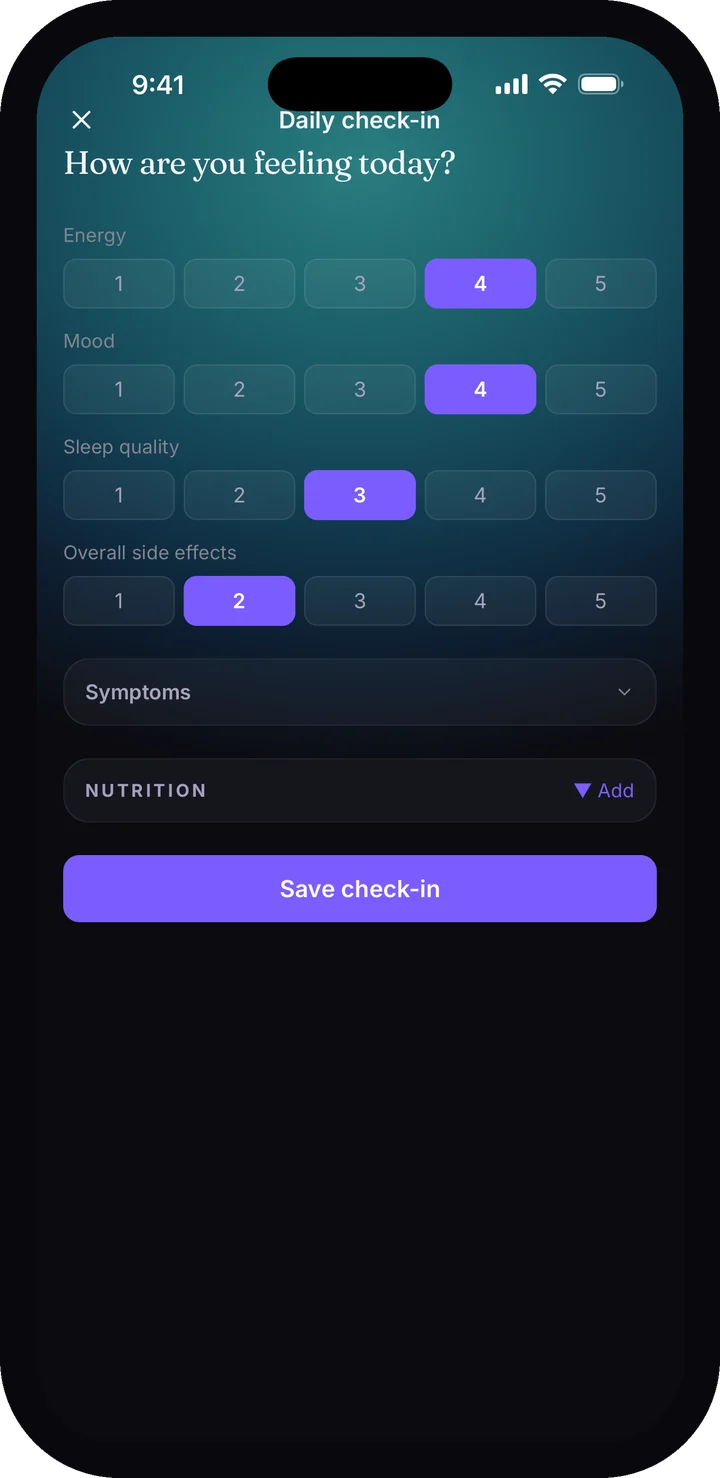
Does a structured log actually change what happens in the room?
It changes what is visible. There is trial evidence that this matters, but it comes from cancer care, not weight management — and from a system that did much more than collect entries. In a randomized trial in 766 people starting chemotherapy for metastatic solid tumours, patients reported 12 symptoms through a web questionnaire at and between visits; severe or worsening entries triggered an email alert to a nurse, and a symptom report went to the oncologist at each visit. Median overall survival was 31.2 months in that group versus 26.0 months with usual care. The alerts and the clinician-facing report were part of the intervention, so the result belongs to the whole system rather than to the act of logging. Nothing like it has been tested in GLP-1 therapy, and it would be wrong to imply the result transfers.
What travels better is the finding underneath it: patients reported symptoms earlier and more often than clinicians recorded them — though the same analysis found clinician reports better predicted events like emergency room visits, so the two records are complementary rather than rival. The one you bring is the half nobody else has.
What to track if you keep it in the app instead
The page above works on paper. If you would rather it filled itself in, Lumara's GLP-1 tracker records the same fields — dose dates, severity on a fixed scale, days since the last injection — and shows the weeks side by side.
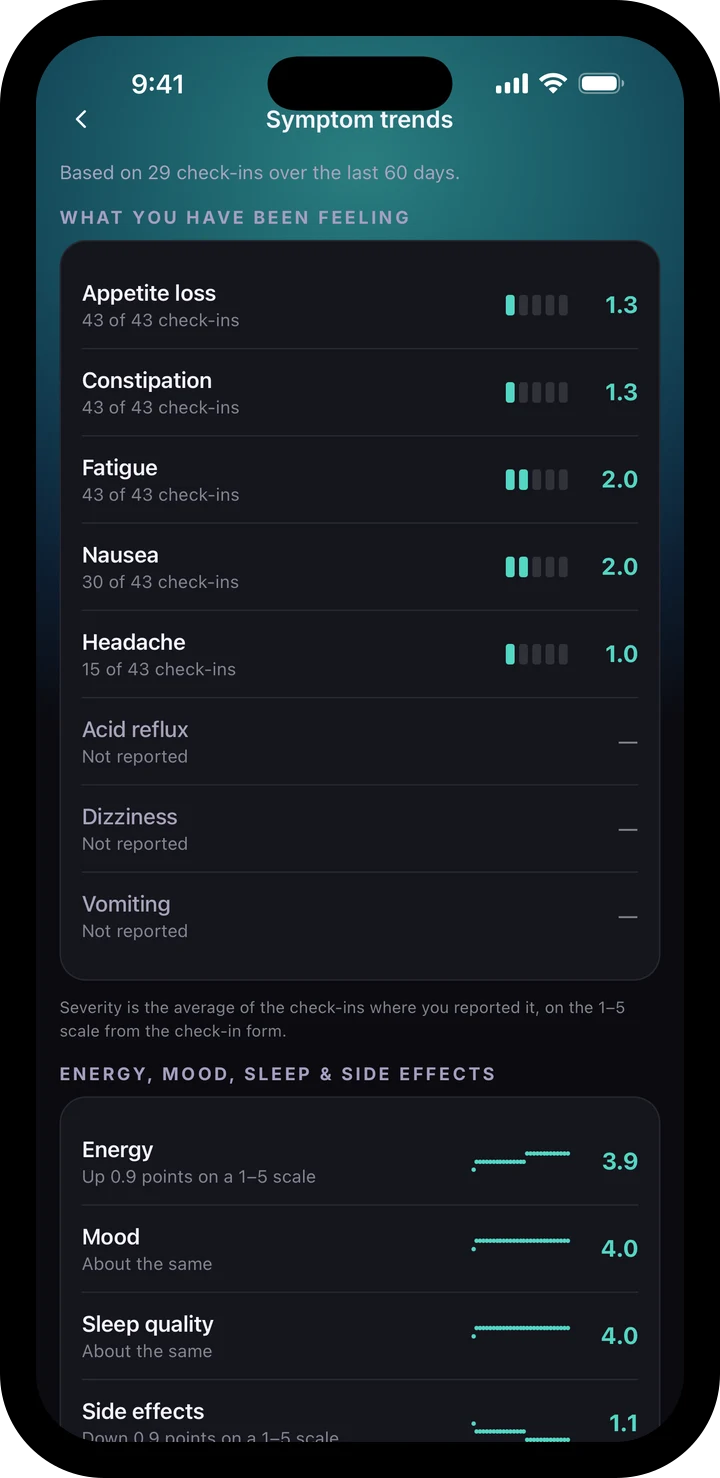
Bring it printed, or bring it on the screen. Either beats trying to remember.