
Two days after the shot you feel steady — sleeping well, clear-headed. By the end of the gap you feel flat, and you cannot tell whether that is the medication or just a bad week at work.
The physiology behind the question is not in dispute. An injection is not a steady drip. It is a slow-release deposit that rises to a peak and falls toward a trough, and the Endocrine Society's clinical practice guideline puts it plainly: in men receiving testosterone enanthate or cypionate, "serum testosterone levels vary during the dosing interval." How steep that ride is depends mostly on one thing — which ester is in the vial.
Whether your own symptoms track that curve is a question for you and your prescriber. This is an explanation of the curve, not a schedule. Your prescriber sets what you take, how it is given and how far apart — that is their decision, informed by your labs and your symptoms, and nothing here changes it.
Why doesn't testosterone just stay at one level after an injection?
Because testosterone on its own clears very quickly, so injectable products are built to release it slowly — and anything released slowly has to rise and fall.
Testosterone itself does not linger. The FDA label for testosterone enanthate states that "there are considerable variations of the half-life of testosterone as reported in the literature, ranging from 10 to 100 minutes."
The fix is chemical. A fatty-acid chain — the ester — is attached to the testosterone molecule, and the result is dissolved in oil. The FDA label for testosterone cypionate describes the mechanism in one sentence: "Testosterone esters in oil injected intramuscularly are absorbed slowly from the lipid phase." The enanthate label uses the same words about its own ester.
So the oil sits in the muscle or the fat as a depot. Molecules leave it gradually, the ester is cleaved off, and testosterone enters circulation. The depot is the reservoir; the ester chain is the tap.
For context on regulatory status: injectable testosterone esters are FDA-approved prescription products and, per the cypionate label, Schedule III controlled substances, indicated "for replacement therapy in the male." For women there is no approved female testosterone product in most countries: the 2019 Global Consensus Position Statement records that "women are using either testosterone formulations approved for men with dose modification, or compounded therapies" — off-label prescribing in both cases — and the same statement says compounded "bioidentical" testosterone therapy "cannot be recommended" for treating low sexual desire, citing a lack of evidence on efficacy and safety.
What actually differs between cypionate, enanthate and undecanoate?
How long the depot takes to empty — which, across the published labels and studies, ranges from about a week to over a month.
- Cypionate. Its label states plainly: "The half-life of testosterone cypionate when injected intramuscularly is approximately eight days."
- Enanthate. Its label publishes no half-life for the ester itself. It describes the identical slow-absorption-from-oil mechanism, and that is as far as the label goes.
- Undecanoate. A different animal entirely. In the phase I pharmacokinetic study of intramuscular testosterone undecanoate, the castor-oil preparation had a half-life of 33.9 ± 4.9 days, against 20.9 ± 6.0 days for a tea-seed-oil preparation — roughly four times cypionate's eight. The FDA label for the approved intramuscular product reports that serum testosterone "reach[es] a maximum after a median of 7 days (range 4 to 42 days)." That product also carries a boxed warning for pulmonary oil microembolism and anaphylaxis, is available only through a restricted REMS programme, and requires patients to be observed "in the healthcare setting for 30 minutes" after each injection — which is why it is not a home injection.
This is the whole reason the same milligram figure means different things in different vials. A longer chain is not a stronger drug. It is a slower one.
Why does a level still build up injection after injection?
Because if the next dose arrives while the last one is still in you, they stack — and they keep stacking until what you clear each interval equals what you put in.
Here is the arithmetic, with deliberately illustrative round numbers rather than any real prescription — these are not amounts, and they are not a schedule. Call the amount in circulation just after an injection 100%. With an eight-day half-life, eight days later 50% is left; eight days after that, 25%.
Now add a second injection at the point where 50% remains. The new peak is not 100% — it is 150%. The one after that lands on 75% and peaks at 175%. The trough climbs too: 50%, then 75%, then 87.5%. The curve is not flat, but the whole curve is drifting upward.
That drift is steady state. Each half-life closes about half of the remaining gap to it, so four or five of them gets you within a few percent. For an eight-day ester that is roughly five to six weeks. For an undecanoate half-life near 34 days it is roughly four to six months.
The practical consequence is that how you feel in week two is not a verdict on the medication. You are still filling the tank. The Endocrine Society's 2018 hypogonadism guideline suggests clinicians "aim at achieving T concentrations in the mid-normal range during treatment" — a target about where the curve settles, not where it starts.
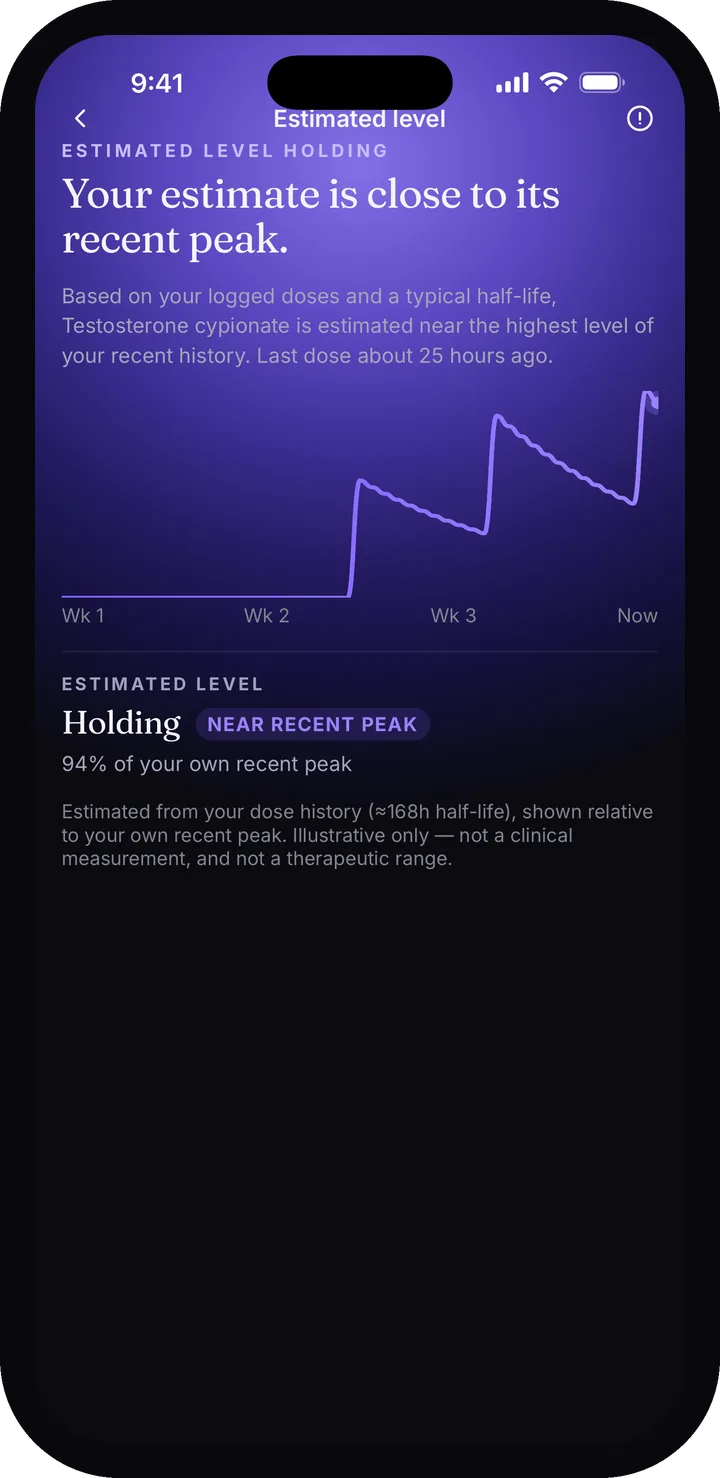
That curve is a model drawn from logged doses and a published half-life. It is not a blood test, it carries no clinical units, and only your provider can interpret an actual level.
Why do a trough draw and a peak draw tell different stories?
Because they are measurements of two different points on the same rising-and-falling curve, and a number without a time attached cannot be read at all.
A draw taken a day or two after an injection catches the top of the ride. A draw taken at the far end of the gap catches the bottom. Both can be entirely ordinary results for the same person in the same week.
This is why timing is a formal part of monitoring rather than an afterthought. The Endocrine Society's monitoring table for men on injected enanthate or cypionate is explicit: "measure serum testosterone level midway between injections." Your provider and the lab decide which point they want, and that choice depends on what question they are asking.
A woman prescribed testosterone off-label is in the same situation with less margin. The 2019 consensus statement asks that women on testosterone be "monitored for their clinical response to treatment and assessed for signs of androgen excess with a serum total testosterone level every 6 months, to screen for overuse" — a check that only means something if the position of the draw relative to the last dose is known.
What you can do — and what nobody but you can do — is record two facts: the exact date and time of your last dose, and the date and time of the draw. Without them the clinician is reading a number with no position on the curve.
Does the route change the shape?
The labels do not offer a like-for-like comparison, but the one subcutaneous product with published kinetics peaks far sooner than the intramuscular one.
The FDA label for the subcutaneous testosterone enanthate auto-injector reports that after weekly subcutaneous injection, serum testosterone "reached a maximum after a median of 11.9 hours," with steady state "achieved by Week 6." The intramuscular undecanoate label reports a median of 7 days. Those differ in ester as well as route, and the intramuscular cypionate and enanthate labels publish no time-to-peak at all — so what the labels show is that ester and route together set the shape, not that either one can be isolated from the published data.
So "what am I on?" is really three questions: which ester, which route, and how far into the interval you are.
What to track if you want this to be readable
You do not need a research protocol. You need four things your prescriber cannot reconstruct from a pharmacy record.
- The date and time of every dose — what actually happened, including the one that slipped by three days.
- The site, if you or your prescriber rotate them.
- Lab draws with the clock time, plus how long it had been since the last dose. This single pairing is what turns a lab result into evidence.
- Symptoms with their date, so energy, mood and sleep can be lined up against position in the interval rather than remembered as a general impression.
If you want to see the decay curve for yourself, the half-life calculator plots it from a half-life and an interval — it carries a cited eight-day preset for testosterone cypionate and a custom field for any other ester, and it runs entirely in your browser. It is a maths tool for understanding the shape. It does not suggest an amount or an interval, and neither does anything else here. That belongs to your prescriber.