
You mixed the vial on a Sunday. The carton said the powder was good until next spring — then the pharmacy label said something completely different, and a forum thread said something different again. Three weeks later there is still liquid in the vial, and you do not know whether it is fine or whether it belongs in the sharps bin.
That gap — between the date printed on the box and the date that actually applies to the vial in your fridge — has a name. It is the difference between an expiration date and a beyond-use date, and seeing why they are two different numbers clears up most of the confusion.
What is a beyond-use date, and how is it different from an expiry date?
A beyond-use date (BUD) is the date after which a prepared medication must not be used, counted from the moment it was compounded — not from the date printed on the manufacturer's carton. That is USP's own wording: a BUD is "the date, or hour and the date, after which a compounded sterile preparation (CSP) or compounded nonsterile preparation (CNSP) must not be used, stored, or transported," and "the date is determined from the date and time the preparation is compounded" (USP beyond-use date fact sheet). The standard that governs how a pharmacy assigns one for a sterile preparation is USP General Chapter <797>.
An expiration date is a narrower promise than people assume. It rests on stability data for a sealed, unopened container stored exactly as the label says — the point up to which that unopened product has been shown to hold its strength and sterility. Every part of that claim assumes nothing has been added and nothing has gone in through the stopper.
A beyond-use date describes something else: this preparation, in this container, mixed or first entered on this date, stored the way the label says. It is a statement about a preparation, not a product.
The two are related in one direction only. CDC states it flatly: "The beyond-use-date should never exceed the manufacturer's original expiration date" (injection safety). It can be a great deal shorter — the label limits quoted below are counted in hours and days — and the moment a vial is reconstituted, the printed expiry stops being the number that matters.
Why does reconstituting a vial start a new, much shorter clock?
Because two things change at once, and both shorten the useful life of what is in front of you.
The first is chemistry. A lyophilised (freeze-dried) powder is stable largely because it is dry: the degradation pathways that break a peptide or protein apart mostly need water to run. Put the water back and they reopen. How much life the wet form has is a question only the label answers — and the answers below are counted in hours and days.
The second is sterility. Before the first puncture the vial is a closed sterile system; after it, a container entered from the outside, with every subsequent withdrawal another opportunity for something to get in. USP <797> treats that risk seriously enough that the conditions a preparation was made under are a primary input into the BUD it may carry. A Category 1 preparation — made in an ISO Class 5 hood that may sit in an unclassified segregated compounding area — is capped at 12 hours at room temperature or 24 hours refrigerated. Category 2, made in a cleanroom suite, and Category 3, which adds sterility testing, reach considerably further (USP fact sheet).
Which is why the new clock is not one you can derive at the kitchen table: it depends on facts about how the vial was made that you were not present for.
What do preservatives have to do with how long a vial lasts?
A preservative is a large part of why two vials of the same drug can carry very different dates. USP General Chapter <51> states that "one or more antimicrobial preservative(s) are expected in all sterile multidose units," added "to inhibit the growth of microorganisms that may be introduced from repeatedly withdrawing individual doses." CDC describes the same split from the practice side: "Single-dose vials typically lack an antimicrobial preservative," while "multi-dose vials typically contain an antimicrobial preservative to help limit the growth of bacteria" — adding that the preservative "does not have an effect on viruses nor does it provide complete protection against bacterial contamination" (injection safety).
The clearest illustration is one FDA-approved product in two presentations. Genotropin (somatropin) cartridges come with a diluent containing metacresol as a preservative, and after reconstitution the label allows refrigerated storage for up to 28 days. The Genotropin MINIQUICK uses a diluent without preservative, and after reconstitution it may be refrigerated for up to 24 hours (prescribing information). Same molecule, same manufacturer, same fridge. The preservative is the whole difference.
Tirzepatide splits the same way. The single-dose pen and single-dose vial of Mounjaro list no preservative among their excipients; the multi-dose vial and the single-patient-use KwikPen — each labelled as holding four doses — contain benzyl alcohol and phenol (prescribing information). Mounjaro is FDA-approved; compounded tirzepatide is not.
Hormone therapy runs on the same principle, for everyone. Delestrogen (estradiol valerate) is supplied in multiple-dose vials preserved with chlorobutanol at 10 mg/mL and with benzyl alcohol at 20 and 40 mg/mL (prescribing information); Depo-Testosterone (testosterone cypionate) carries benzyl alcohol as a preservative and comes as a multiple-dose 10 mL vial alongside a single-dose 1 mL vial (prescribing information). Both are FDA-approved, and in both the preservative is what lets the larger vial be entered more than once.
The diluent follows the same logic. Bacteriostatic Water for Injection contains benzyl alcohol as a preservative and is supplied as "a multiple-dose container from which repeated withdrawals may be made." Sterile Water for Injection has none. Which one the pharmacy specified is part of your answer — and that choice is theirs, not a substitution to make at home.
Does "in use" mean the same thing as "expired"?
No — and even manufactured, never-reconstituted products make the distinction. The label for Ozempic (semaglutide), an FDA-approved product, states that "after first use of the OZEMPIC pen, the pen can be stored for 56 days at controlled room temperature 15°C to 30°C (59°F to 86°F) or in a refrigerator" (prescribing information). That window runs from first use, not from the date on the carton. The in-use limit is the one that governs.
Clinical practice runs the same rule: CDC guidance is that once a multi-dose vial is punctured it should be dated and discarded within 28 days, unless the manufacturer states another date for that opened vial (CDC injection safety).
"Expired" describes the sealed product; "beyond use" describes the one you opened. A vial can be well inside its printed expiry and long past the date it should have been discarded.
Why can't I just look up how long my mixed vial lasts?
Because a beyond-use date is a statement about one specific preparation, and only the pharmacy that made it knows the inputs. USP lists the risk elements a Category 2 BUD is assigned on: the compounding method, whether sterility testing was performed, whether the starting components were sterile or nonsterile, and the storage conditions afterwards (USP fact sheet) — to which add which diluent was used and whether it was preserved. Change any one and the number changes.
A figure from a forum describes somebody else's vial. It may be right for them and quietly wrong for you.
Regulatory status sharpens this. Compounded drugs are not FDA-approved, and FDA does not verify their safety, effectiveness or quality before they are marketed. Compounding done by a state-licensed 503A pharmacy is not subject to the same manufacturing requirements as a 503B outsourcing facility, which registers with FDA and is inspected against CGMP standards. FDA has separately reported more than 990 adverse-event reports associated with compounded semaglutide and more than 730 associated with compounded tirzepatide, and says the dosing errors it saw "resulted from patients measuring and self-administering incorrect doses of the drug, and in some cases, health care professionals miscalculating doses." And compounds sold "for research use only" are not approved for human use by anyone — nobody in that chain is accountable for a beyond-use date at all.
So the answer lives in one of two places: the label on the vial, or the pharmacy that dispensed it. Your prescriber and your pharmacist set the dates, the same way they set the amounts.
What should I write down when I mix a vial?
The date and time you reconstituted it, the beyond-use date the pharmacy gave you, which diluent was used, and where it is being stored. Because a BUD counts from the moment of compounding, it is arithmetic you can only do if you recorded the start — and that start is the single piece of information no label can carry for you.
The arithmetic is trivial once the inputs exist. Purely as an illustrative example: a vial mixed on the 3rd of a month, with a pharmacy-assigned beyond-use date 28 days out, reaches that date on the 31st. Those numbers are invented for the example — your pharmacy's label sets the real one.
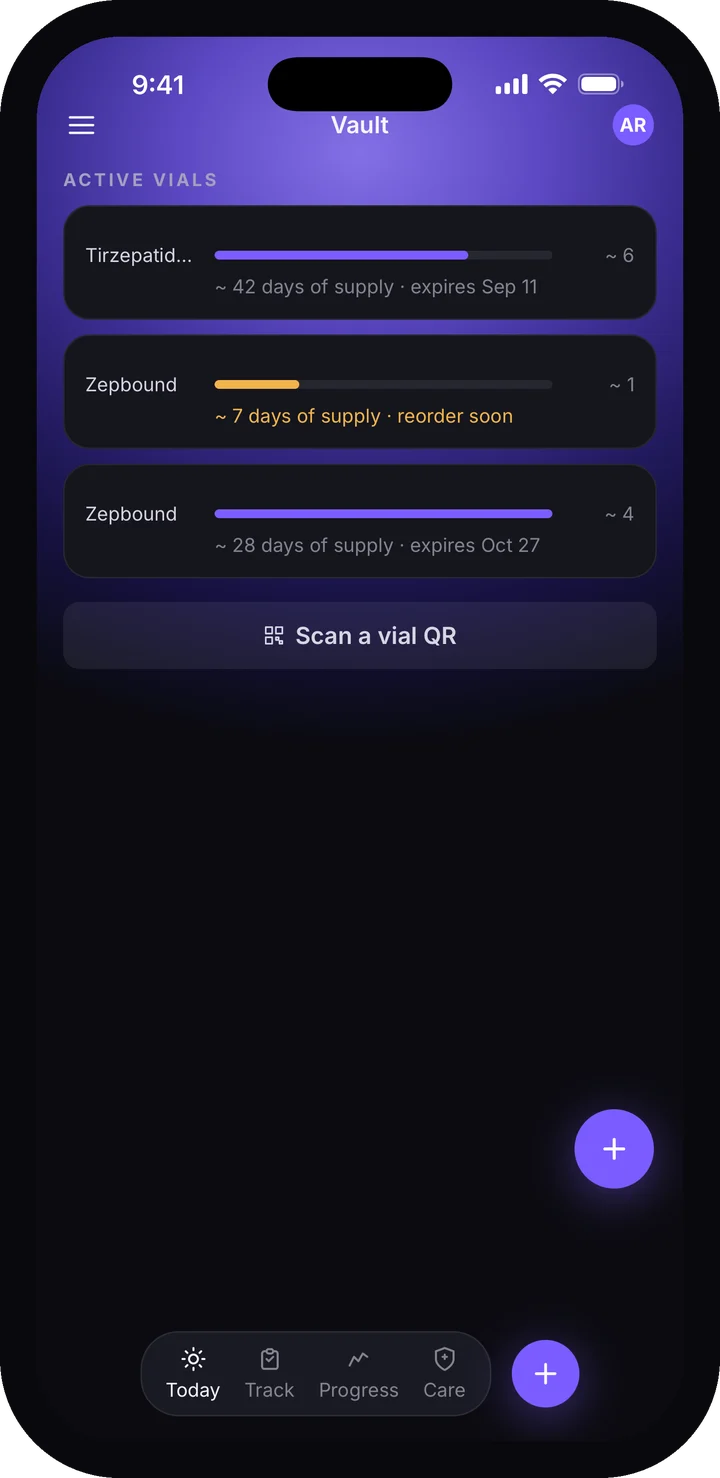
That is the job Lumara's vial records do: you enter the mix date and the beyond-use date from the label, and the remaining life sits on the screen rather than in your memory. To see the arithmetic worked through first, the vial longevity calculator runs it from your own inputs and shows every step — it computes from what you type in and never suggests a date of its own.
Bring the vial, or a photo of its label, to your next appointment. The date on it is a clinical decision somebody already made for you — worth being able to read.